

Thanks for reading! If you haven’t subscribed, please click the button below:
By subscribing, you’ll join over 85,000 people who read Apricitas!
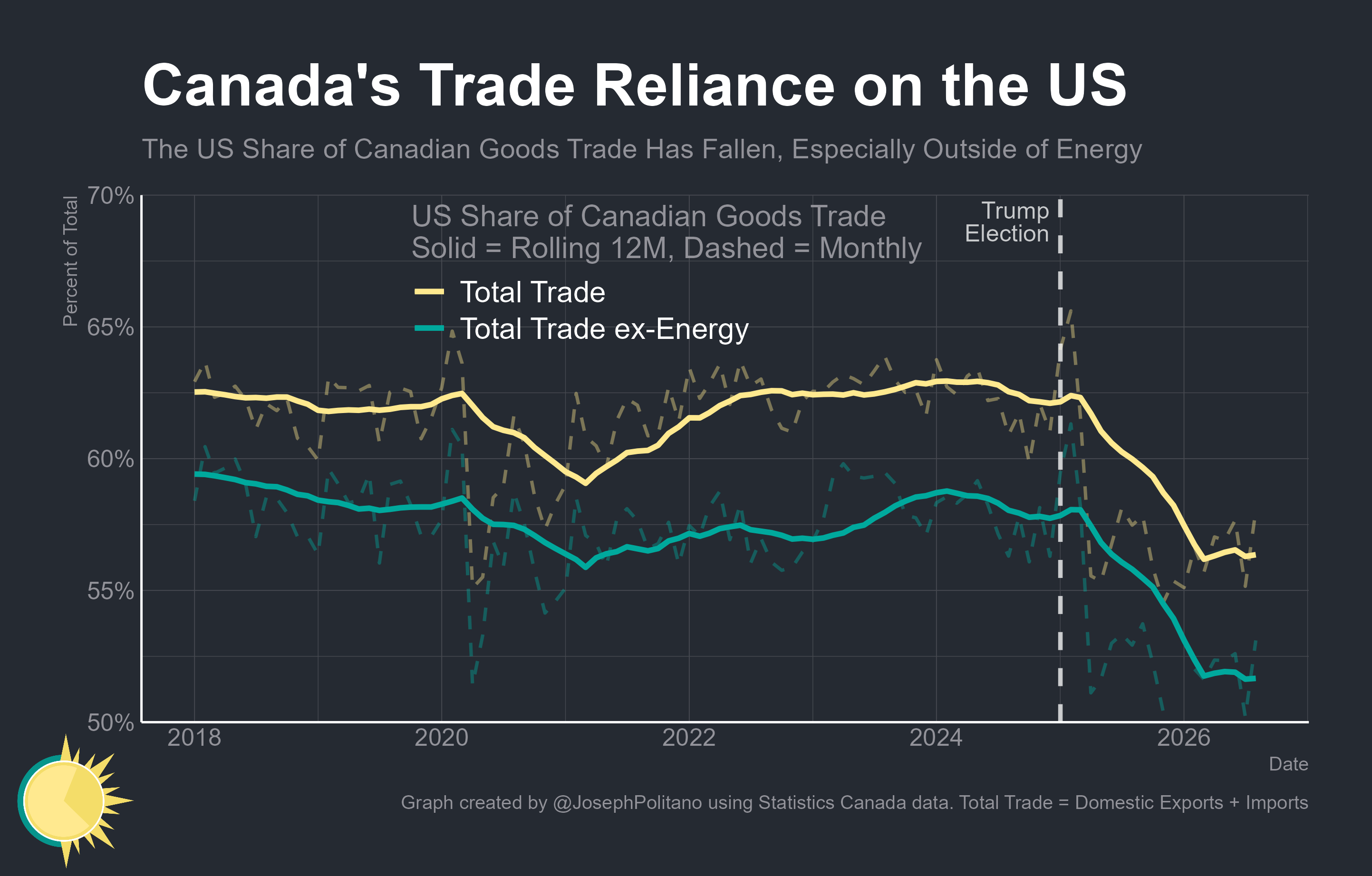
Canada is increasingly decoupling from the US economy—the share of Canadian trade flows headed to the US has fallen to the lowest level in more than 30 years, with both US import and export shares dropping significantly since 2025. Trump’s trade war, consumer boycotts, and a formal Canadian government push to boost non-US trade have all reduced the country’s economic reliance on its southern neighbor.
When Donald Trump began his second term, he almost immediately began an unprecedented campaign to break the longstanding US-Canada trade relationship. Canada was among the first countries he hit with major tariffs, which, coupled with endless threats of annexation and clandestine meetings with separatist groups, forced the government in Ottawa to stop seeing America as a reliable economic partner.
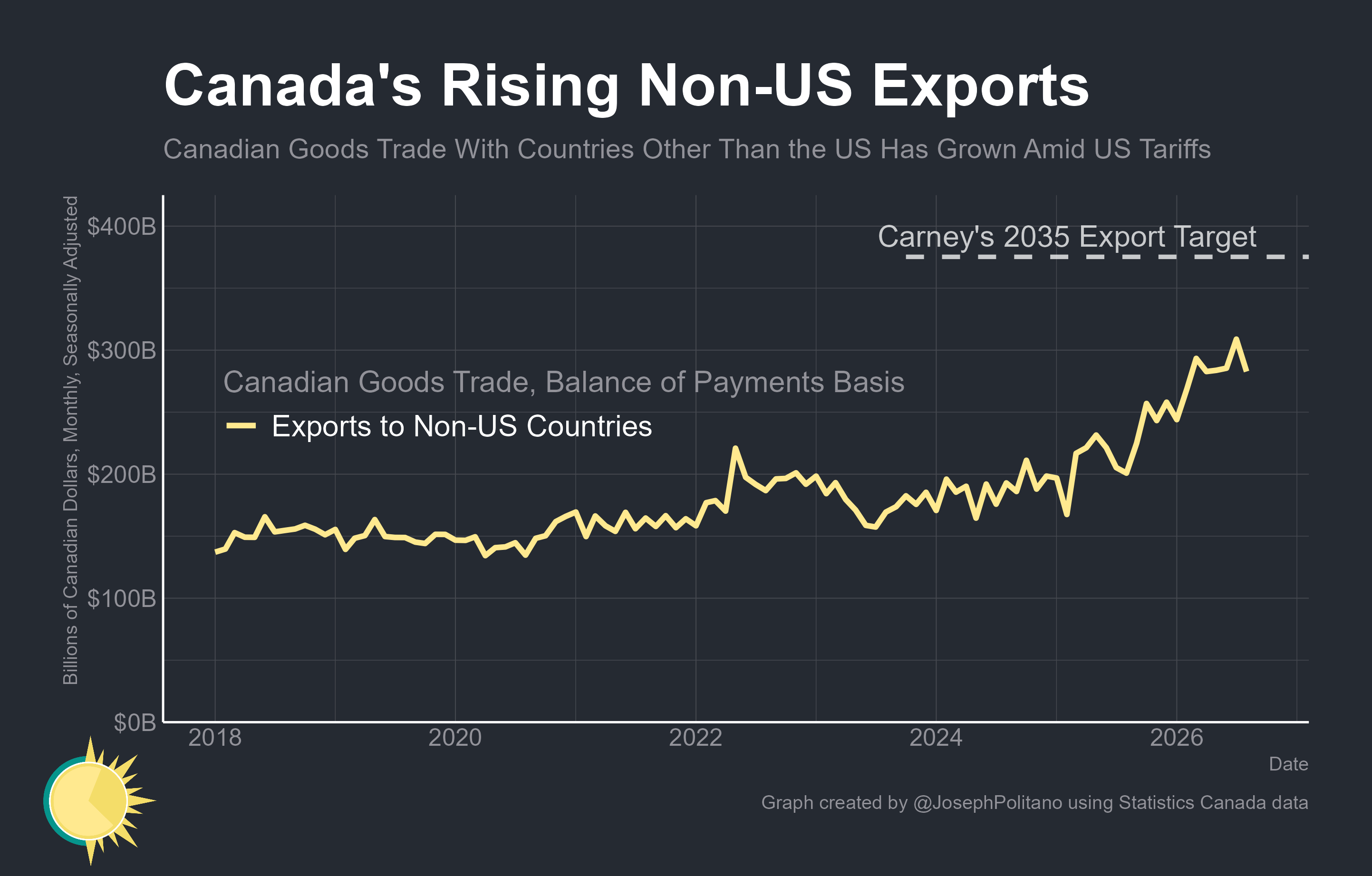
In 2025, Canadian Prime Minister Mark Carney set a goal of doubling the country’s non-US exports over the next decade, saying that “many of our former strengths based on close ties to America have become our vulnerabilities.” Today, he is already halfway to achieving that goal, with Canada’s non-US exports up more than 40% over the last twelve months alone. Yet this still leaves America as far-and-away the country’s largest trading partner, 8 times as big as the second-place EU. The structural factors that made the US-Canada trade relationship so valuable also make significant decoupling painful and difficult.
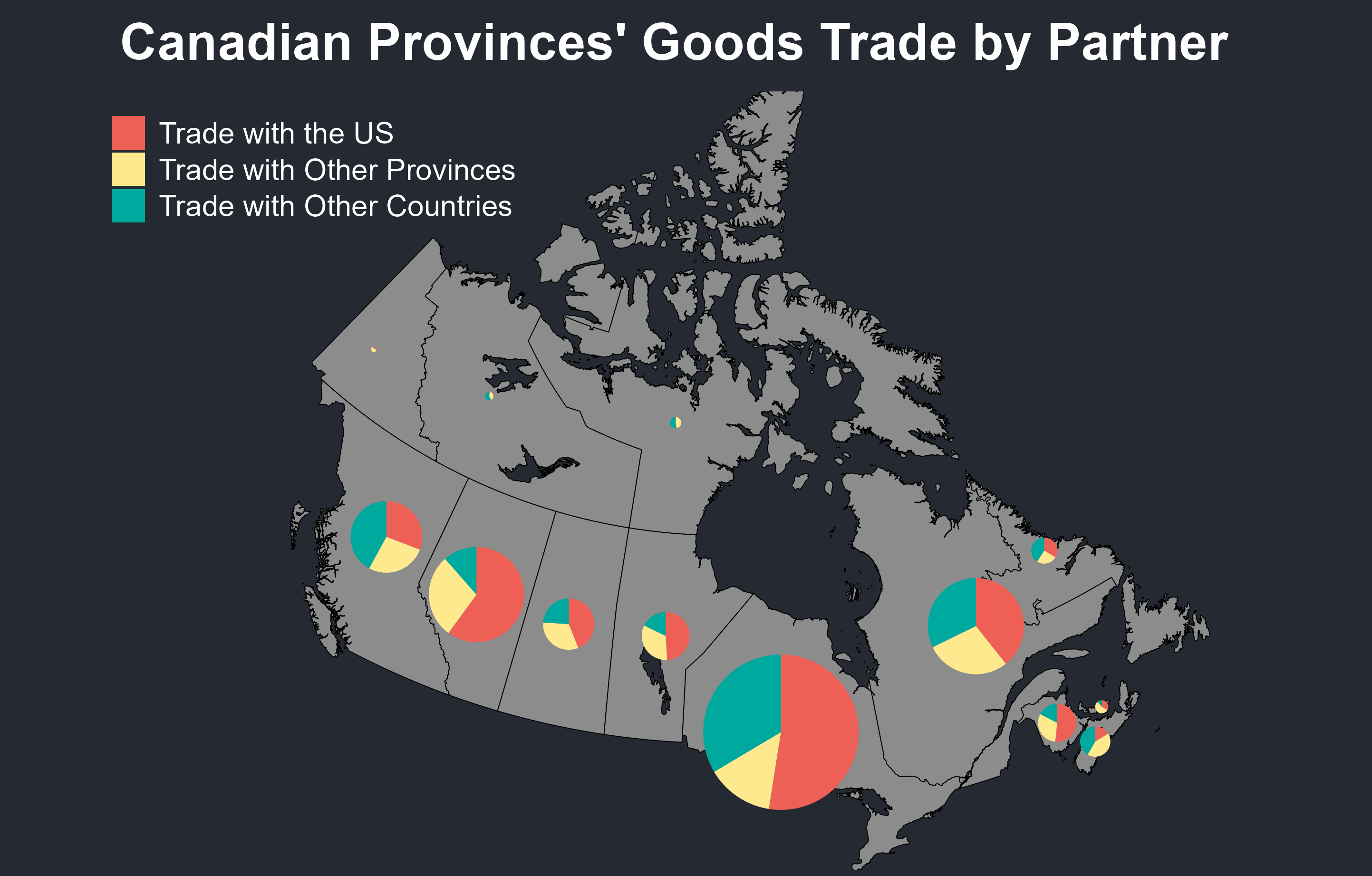
Canada has a much smaller population and lower income than the US, making its total economy comparable in size to individual states like New York or Texas. Most major Canadian cities are physically closer and have stronger legacy infrastructure connections to their American neighbors than to other cities in Canada, meaning almost every major Canadian province trades more with the US than with the rest of Canada, let alone with other overseas markets. Canada’s economy has already grown significantly slower than America’s in the half-decade since COVID. Canada’s non-US exports have been boosted by the twin tailwinds of rising energy and gold prices, a lucky break outside the government’s control and unlikely to be replicated. Achieving further decoupling would require additional trade-offs between long-term security and short-term economic growth.
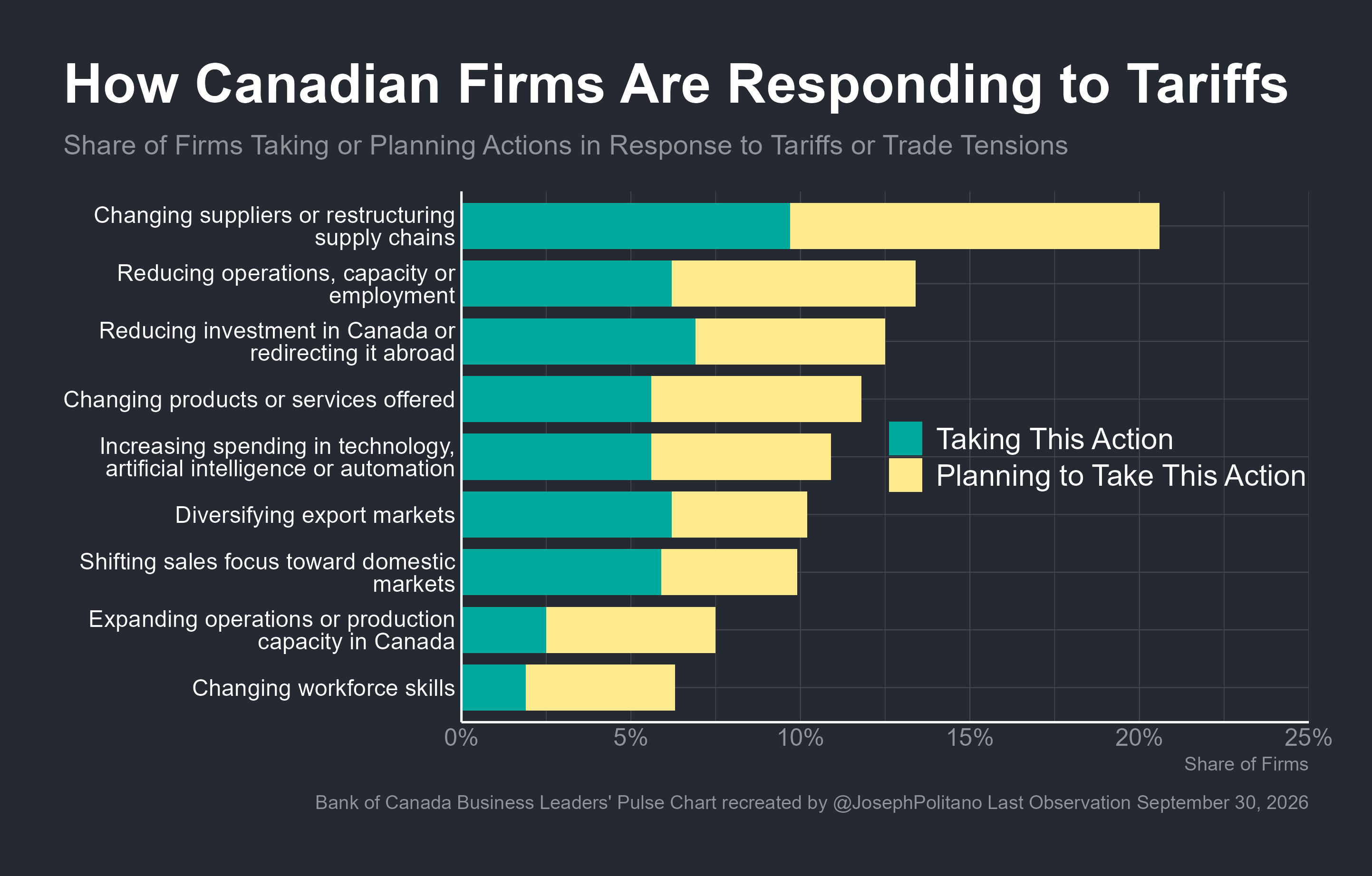
In the Bank of Canada’s regular business outlook survey, more than 20% of Canadian businesses are planning to or have already restructured supply chains due to the trade war, and another 10% are in some stage of diversifying their export markets. Yet the survey also makes the economic costs obvious—those reducing Canadian operations outnumber those expanding operations nearly 2 to 1, and nearly 13% of businesses are reducing investment in Canada or redirecting it abroad.
This quarter’s survey also occurred just as Trump hit another $20B worth of Canadian goods with tariffs while threatening to double the tariffs on Canadian vehicles at the start of 2027. This gives a unique opportunity to measure the tariffs’ impact on Canadian business sentiment by comparing results immediately before and after the executive orders—in total, the new tariffs and threats knocked nearly 4 percentage points off export growth expectations, added half a percentage point to inflation expectations, and caused 25% of firms to revise down their domestic investment.
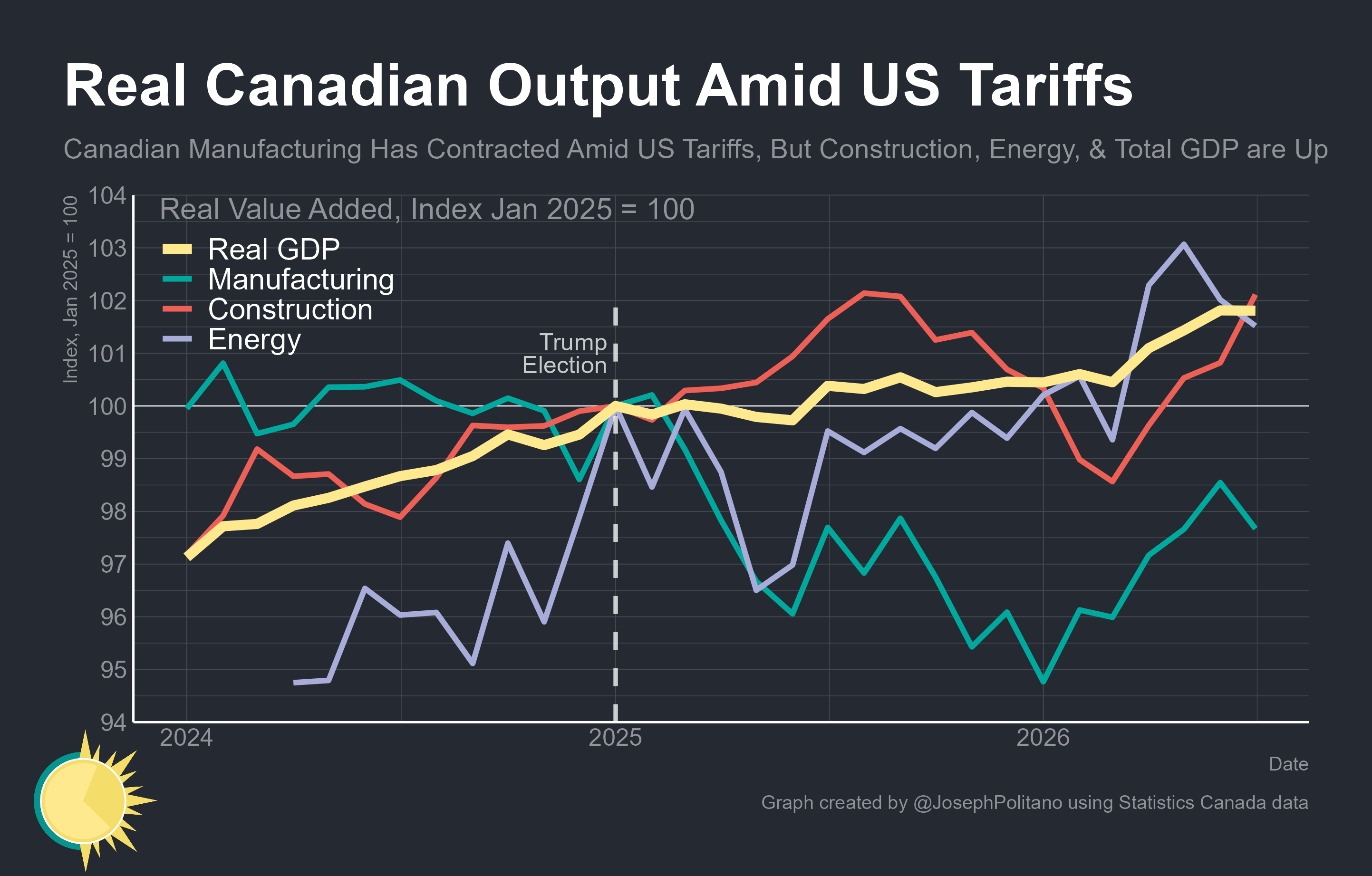
However, the Canadian economy may already have weathered the worst of the storm—the initial tariff shock significantly hurt Canadian industry, especially in the manufacturing sector, but growth has already begun to rebound. After completely stagnating in 2025, Canadian GDP has increased 1.4% in 2026, with real manufacturing output up 3.5%, construction up 1.8%, and energy up 1.3%.
The steps already taken to decouple from the US economy mean Trump’s tariffs and threats carry less teeth than they would have even a couple of years ago. While Canada cannot fully escape America’s economic gravity, decoupling has protected the country from the worst impacts of tariffs and increased its leverage in trade negotiations.
The Details of Decoupling
Earlier this month, I visited Windsor and Toronto as part of an international learning trip organized by the Friedrich Ebert Foundation, rounding out a series of trips to Toronto, Montreal, and Vancouver I’ve taken over the last year. In speaking to Canadian politicians, union leaders, business executives, and members of the public, the overwhelming theme was just how deeply Canadian trust in America has been severed.
Nobody believes Trump will abide by the deals he’s made, and nobody believes any future administration will make the changes necessary to prevent the resurgence of Trump-like nationalism. Canadians are taking these threats extremely seriously—I met political staffers who took burner phones into the US to guard against espionage, businesses who were gaming out how they would respond to being cut off from US AI models, and plenty of consumers who were going out of their way to avoid American products. In another recent Bank of Canada survey, 46% of Canadians believe the most serious effects of the trade war are still to come, compared to 27% who think the worst is already behind them.
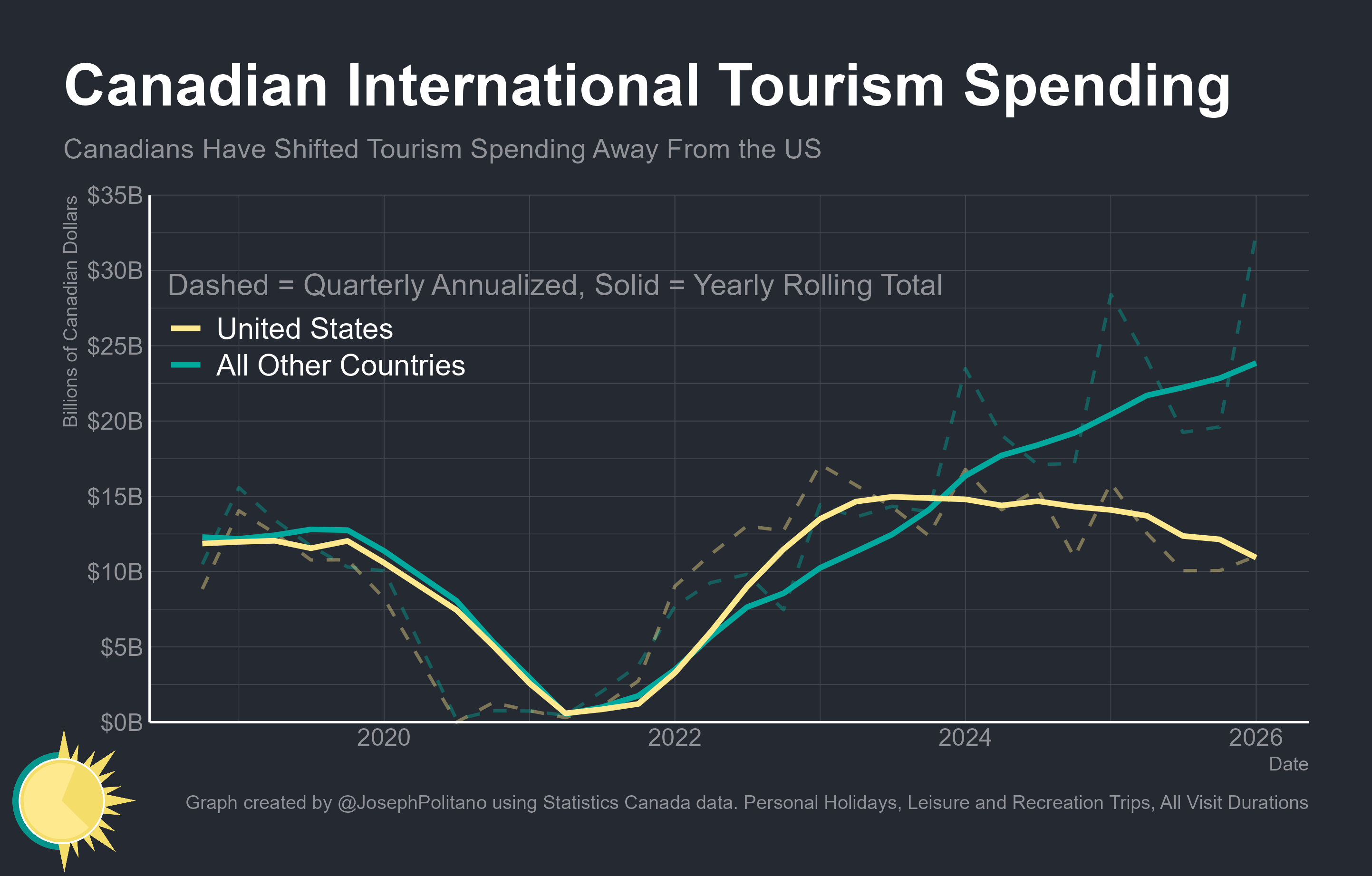
Perhaps nothing encapsulates the Canadian public’s anger more than the rapid drop in tourism to the US—personal spending on visits to America has dropped 24% compared to 2024, while spending on other overseas destinations has a mirrored 24% increase. Much of the drop in US-Canada trade comes from similar boycott dynamics that extend to cars, alcohol, groceries, electronics, and more.
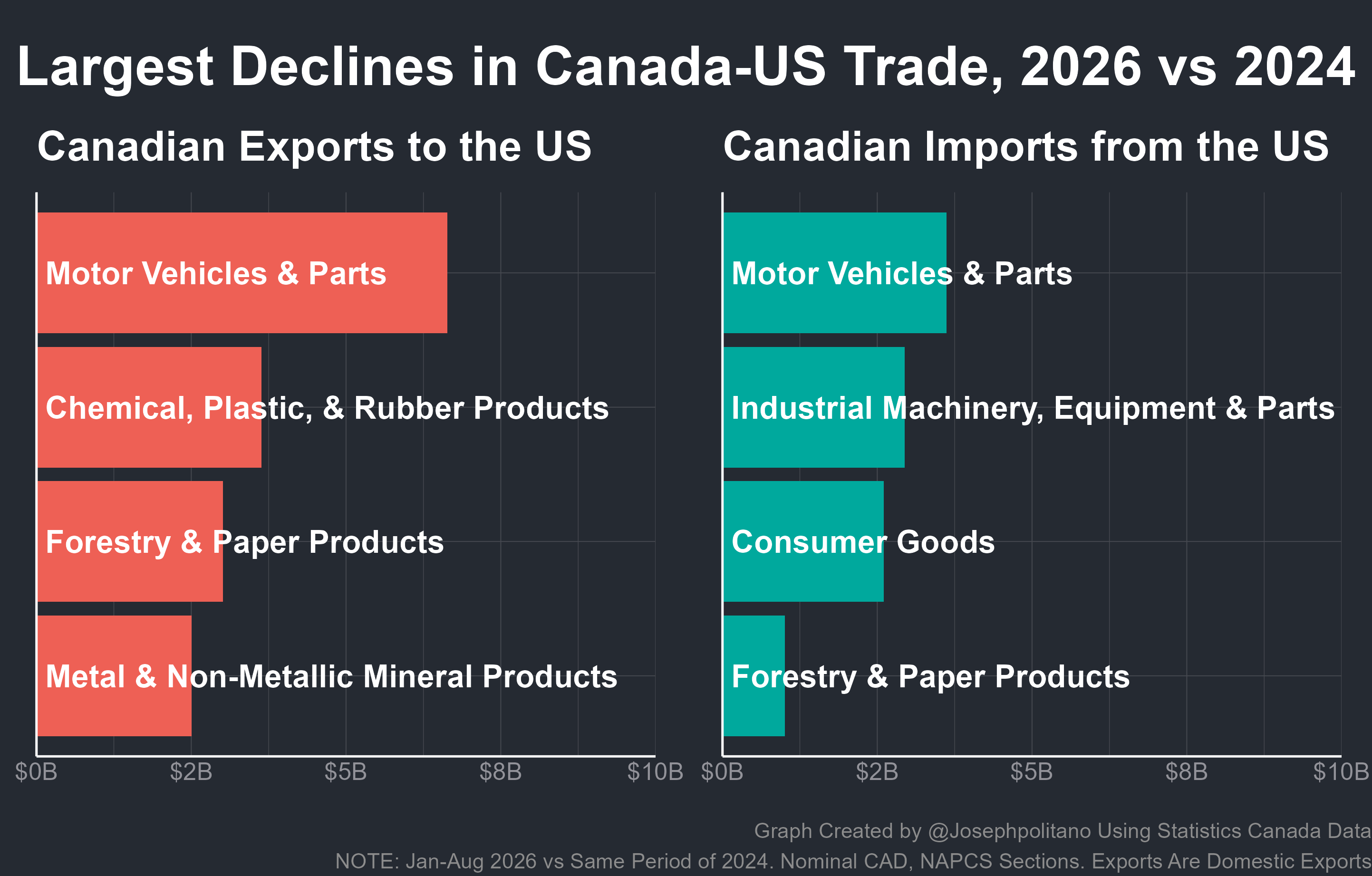
On the export side, the vast majority of Canadian goods still enter the US tariff-free, either because they fall under the blanket sectoral exemptions (such as energy, tech, or agriculture) or because they fall under specific country-level exemptions for USMCA-compliant goods. Yet Canada has arguably been hit hardest by the sectoral tariffs placed on goods of all countries, because those targeted industries make up a large share of Canadian manufacturing and are the sectors most intertwined with the US. Motor vehicles, forestry & paper products, and metal & mineral products are all affected by these sectoral tariffs, so it’s not a coincidence they represent three of the four sectors with the largest drop in Canadian exports to the US.
On the import side, the $2B drop in Canadian purchases of American consumer goods (even without adjusting for substantial inflation) highlights how impactful boycotts and retaliatory tariffs have been. The drop in motor vehicle & parts imports reflects similar dynamics, plus the more damaging supply chain decoupling occurring as some Canadian factories get cut out of US production flows. Perhaps most worrying for Canadians is the reduction in industrial machinery and equipment imports, which are downstream of painful declines in domestic investment just when the country needs to retool its factories the most.
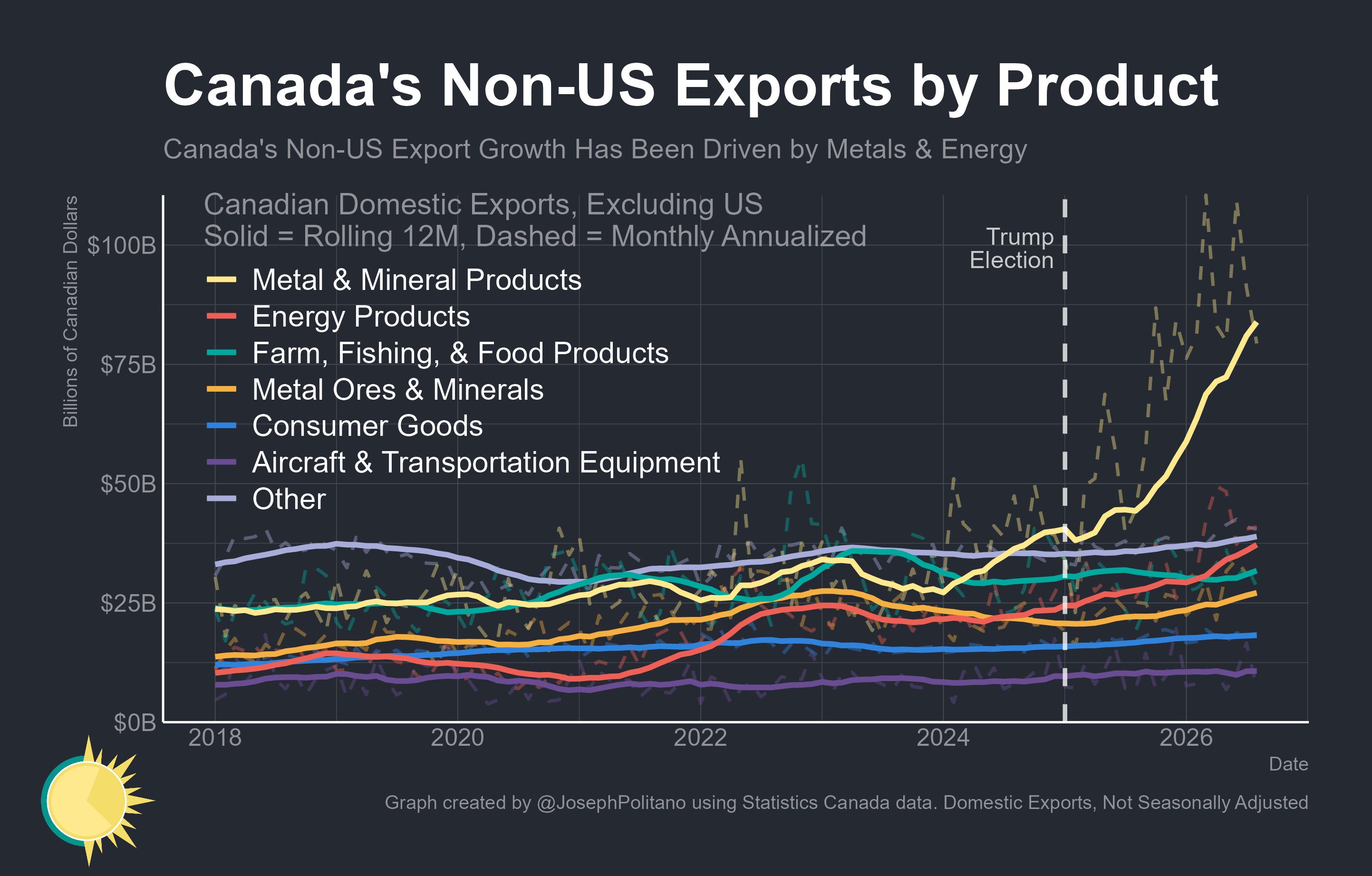
The flipside of Canada’s shrinking trade with the US is its growing trade with the rest of the world. Among non-US exports, natural resources lead the way, with metal and mineral exports skyrocketing 125% since 2024, and non-US energy exports also hitting record highs by rising 80%. Even outside those sectors, the story is largely one of healthy broad-based growth—overseas exports of metal ores are up 40%, exports of consumer goods are up 15%, exports of food are up 14%, and exports of aircraft and parts are up 11%.
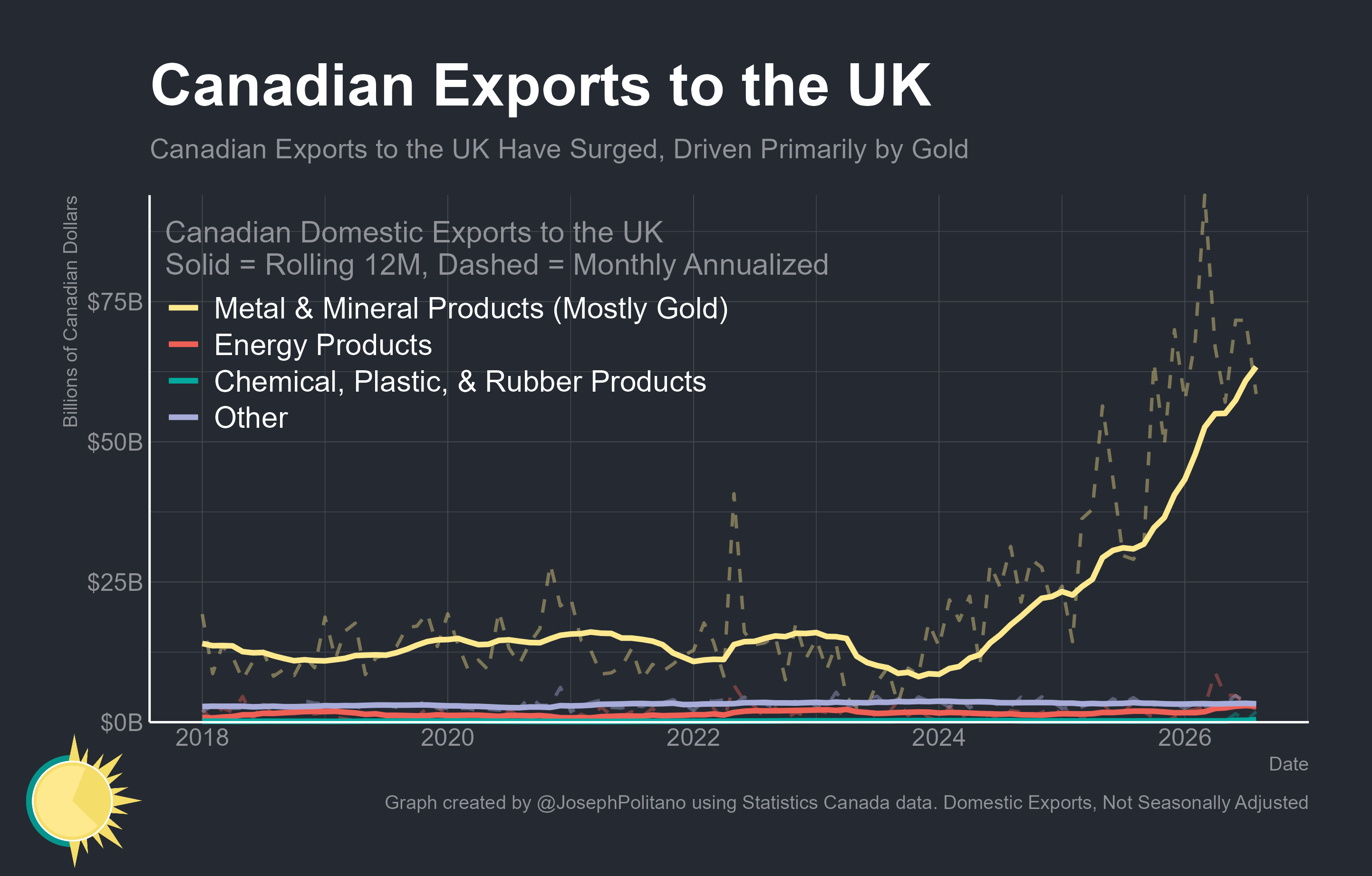
Much of the rise in metal and mineral exports consists of Canada’s gold exports to vaults in the UK, which now completely dominate British-Canadian trade flows. Canada has a much more robust gold mining and refining industry than most countries, so it has benefitted tremendously from the boom in gold demand since 2024. Still, this growth should be partially discounted because much of it is price inflation and reexport trends rather than direct growth in economic output.
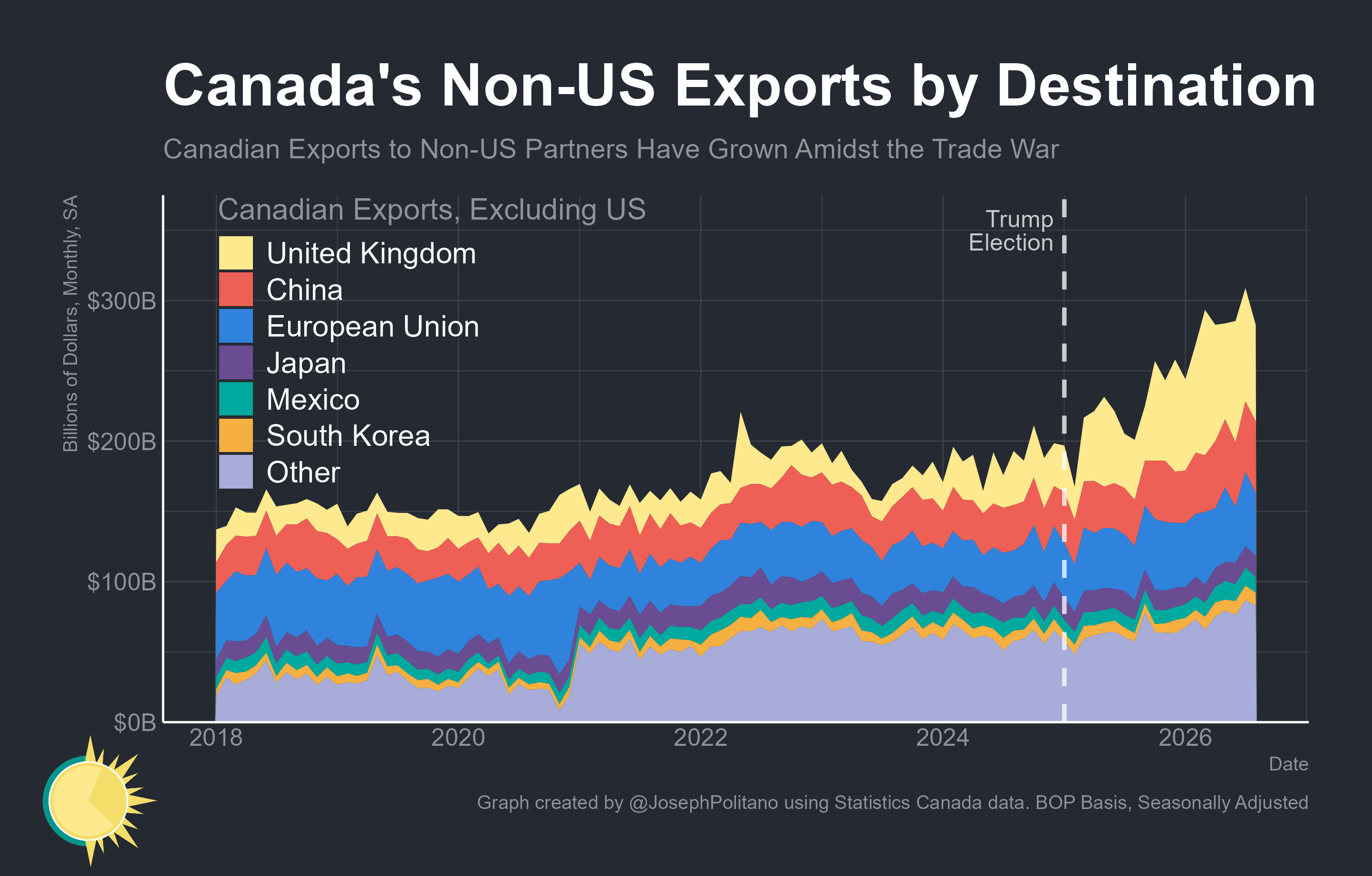
Stepping back, that surge in gold exports has allowed the UK to leapfrog over China and the EU to become Canada’s new 2nd-largest export destination. Yet even excluding the rapid increase in British trade, Canada’s non-US exports are still at a record high. Exports to China are up 52%, exports to the EU are up 42%, and exports to other countries are up 18%.
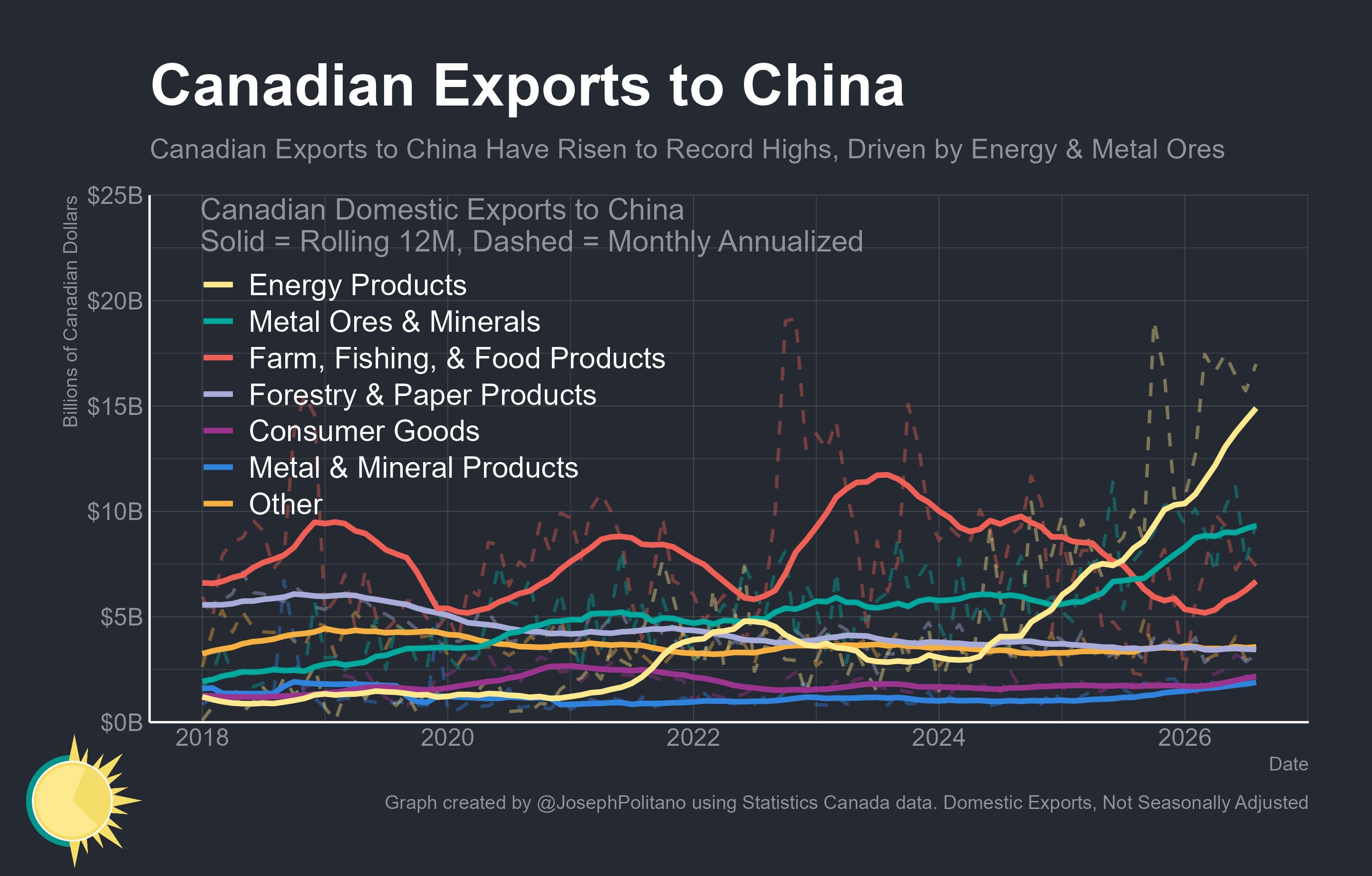
With regard to China, Canadian exports of energy, raw ores, and minerals have more than offset a decline in agricultural exports. Rising energy prices amidst the American war with Iran have forced China to seek out other fossil-fuel providers, and ravenous global demand for industrial inputs has helped redirect Canadian metal production away from the US. Canadian agricultural exports have not recovered from the Chinese counter-tariffs placed when Canada taxed Chinese EVs during the Biden administration, yet an agreement signed earlier this year has already undone some of the export losses. Overall, Canada’s export diversification has not been wholly reliant on one product or one partner.
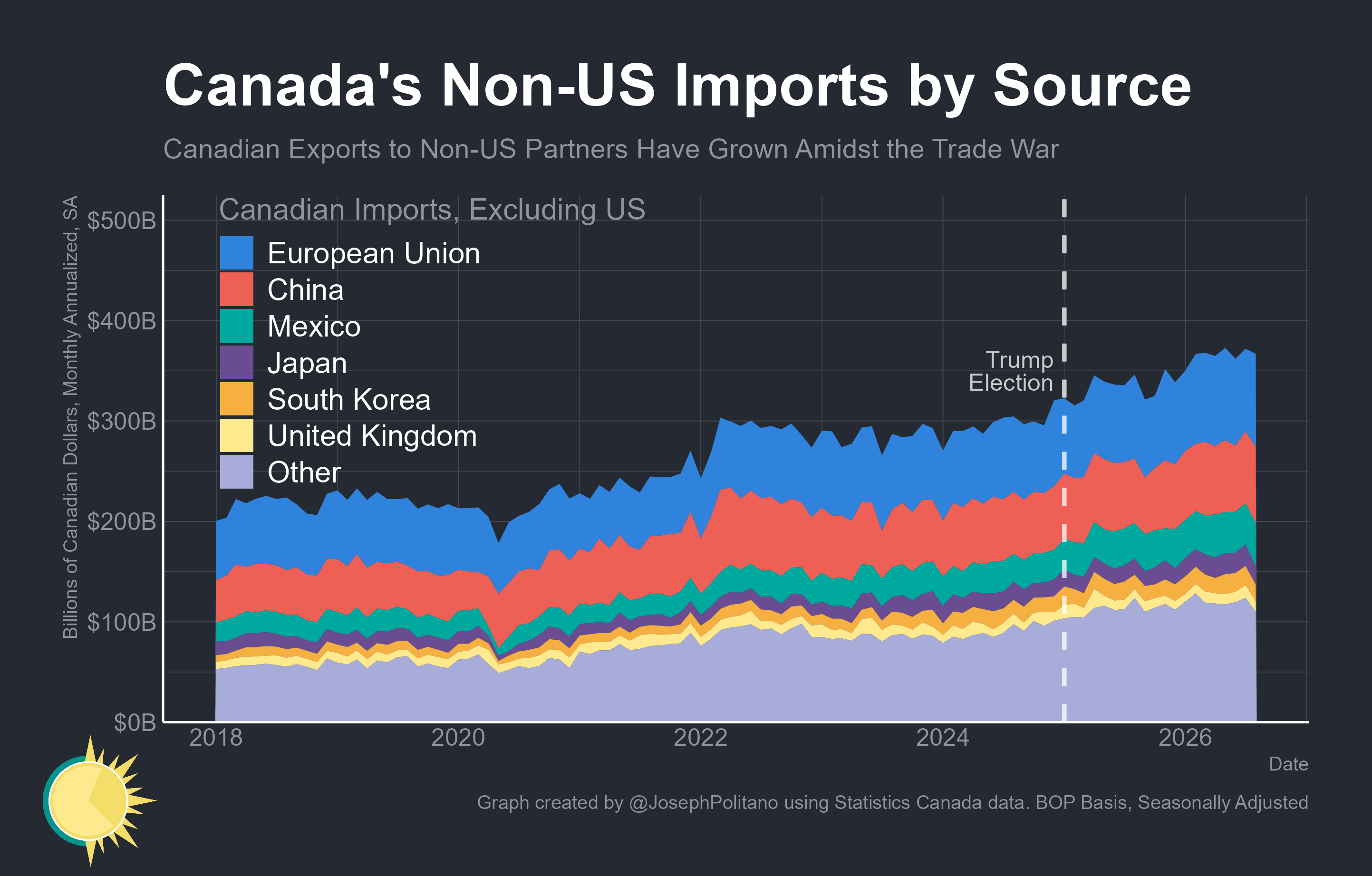
On the import front, the changes have been less dramatic—Canada was already less reliant on America as an import source than as an export destination, and so the trade war has only driven gradual broad-based increases in Canadian purchases of non-American goods. Even Canada’s much-publicized decision to suspend its 100% tariff on Chinese EVs and instead implement a 49k-vehicle quota has been less impactful than expected, with fewer than 16k slots used so far. The trend is still clear, though, as Canada’s import reliance on the US continues declining to new lows.
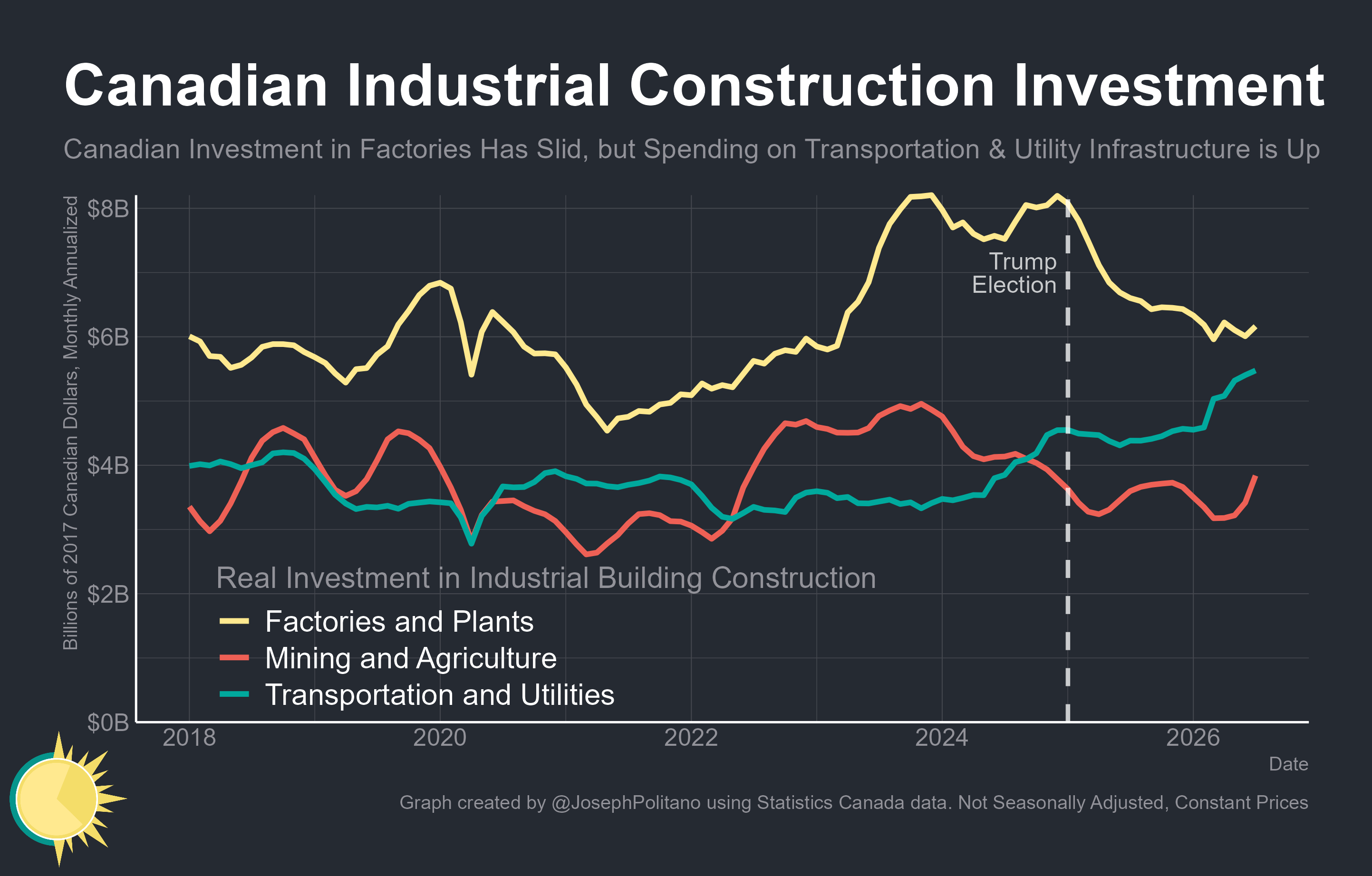
Shifting further away from the United States will require a long-term reorienting of Canadian infrastructure—hence the opening of the Major Projects Office to fast-track the pipelines, ports, and power lines needed to get Canadian goods to overseas markets. Designating the Pacific Link pipeline, which will connect more Albertan oil to Canada’s west coast ports, as the office’s first national interest project was an obvious signal that the government is serious about prioritizing export diversification. Real Canadian investment in this kind of transportation and utility infrastructure is now continually hitting new record highs, already up 42% from this time in 2024.
But so far the Major Projects Office has been fighting a losing battle against the overall downturn in the business environment—Canadian investment in factories, mines, and plants has declined significantly across Carney’s tenure, counteracting the rise in infrastructure construction and leaving overall industrial investment flat. To succeed in the difficult economic work of decoupling, Canada will have to reinvigorate its manufacturing sector in addition to renewing its infrastructure.
Conclusions
When Trump first began his trade war against Canada and Mexico, I wrote that the two countries could “outlast him politically even if they cannot economically” as tariffs would likely cost Trump support while causing voters to rally around Carney & Sheinbaum. That’s certainly been borne out, as Trump has been forced to ease Canada tariffs several times for political reasons, most recently exempting several agricultural supplies in a last-ditch bid to save the Senate campaign of Maine’s Susan Collins. Meanwhile, Mark Carney is more popular than ever.
This should not be surprising, as the majority of the economic costs of tariffs are paid by the country imposing them. American tariffs on Canada were particularly counterproductive because so many Canadian goods are intermediate inputs for American factories, and Canada is one of the few countries where the US actually ran a surplus in manufactured goods. The damage on the American side of the border has been larger, even if Canada’s situation is more existential because its economy is proportionally smaller.
If Democrats do take control of the House and Senate in the midterm elections next week, Trump will likely refocus on trade wars and foreign policy given his reduced power over domestic affairs. The administration has constantly talked about “renegotiation” of the USMCA trade agreement signed in Trump’s first term but has repeatedly put it off; they will certainly have to address it during their last two years in power. When they do, Canadians will be thankful they aren’t quite as dependent on America as they used to be.
It looks like Canada is trying to enact a carefully thought out plan with some long-term implications.
It’s a bit hard to argue with this: Nobody believes Trump will abide by the deals he’s made, and nobody believes any future administration will make the changes necessary to prevent the resurgence of Trump-like nationalism.
Although I do wish it were different.
This is really impressive! Melanie Joly wants Canada to start rolling steel. I heard something about sawmills adopting metric measurements / European standards, not sure where that is.