

Thanks for reading! If you haven’t subscribed, please click the button below:
By subscribing, you’ll join over 80,000 people who read Apricitas!
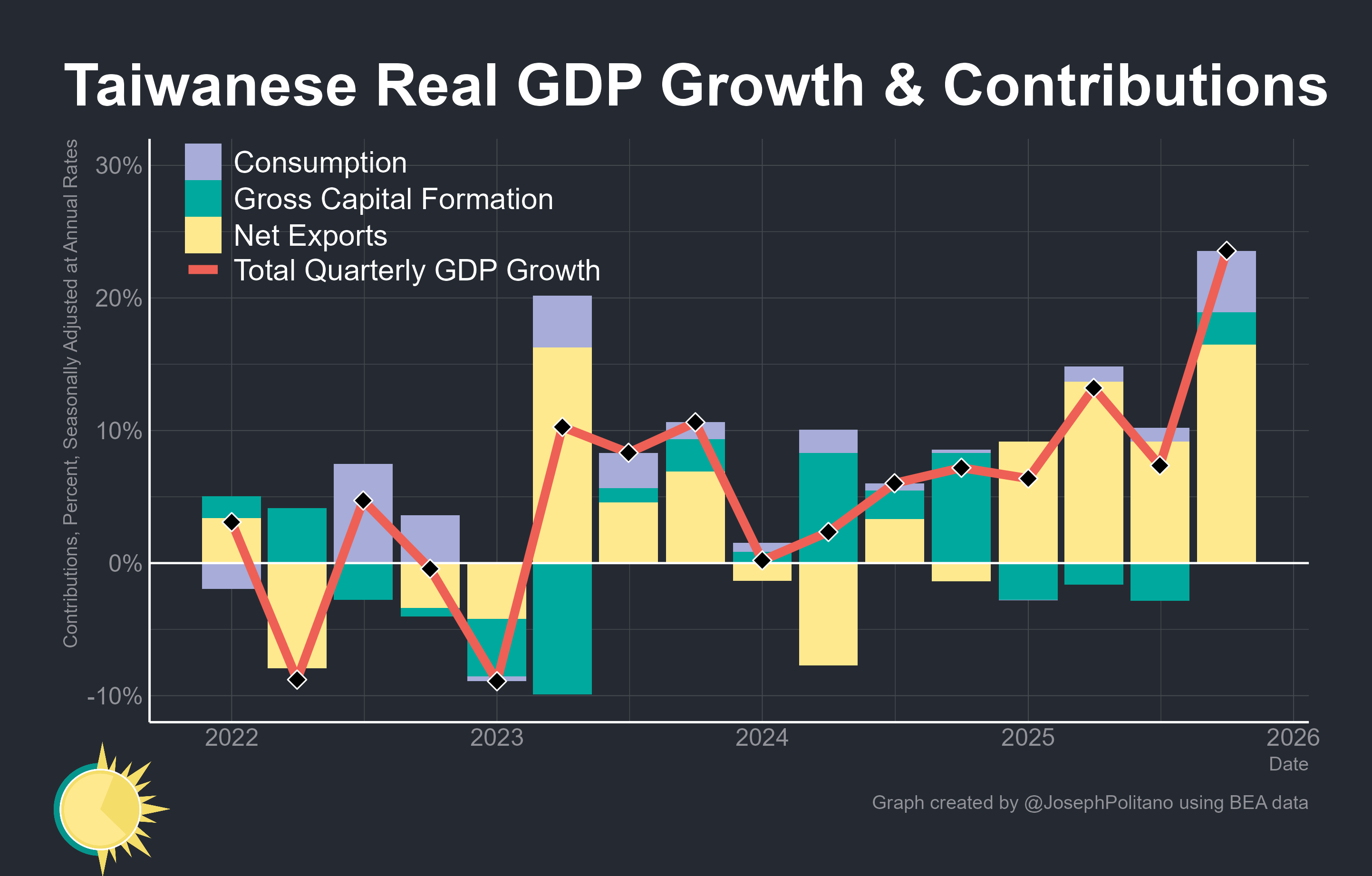
If people are mining for gold, it’s good to sell shovels. And if there’s a gold rush, it’s good if 30% of your nation’s economy is based on shovel manufacturing. Taiwanese GDP rose at a mammoth 23.6% annualized rate in the last quarter of 2025, the fastest pace since the nation’s initial recovery from the 2008 recession, as ravenous demand for AI chips from Taiwan Semiconductor Manufacturing Company (TSMC) buoys the nation’s economy. Growth in net exports has driven the vast majority of this boom, as data center builders in the US, China, and beyond try to get their hands on as much compute as possible.
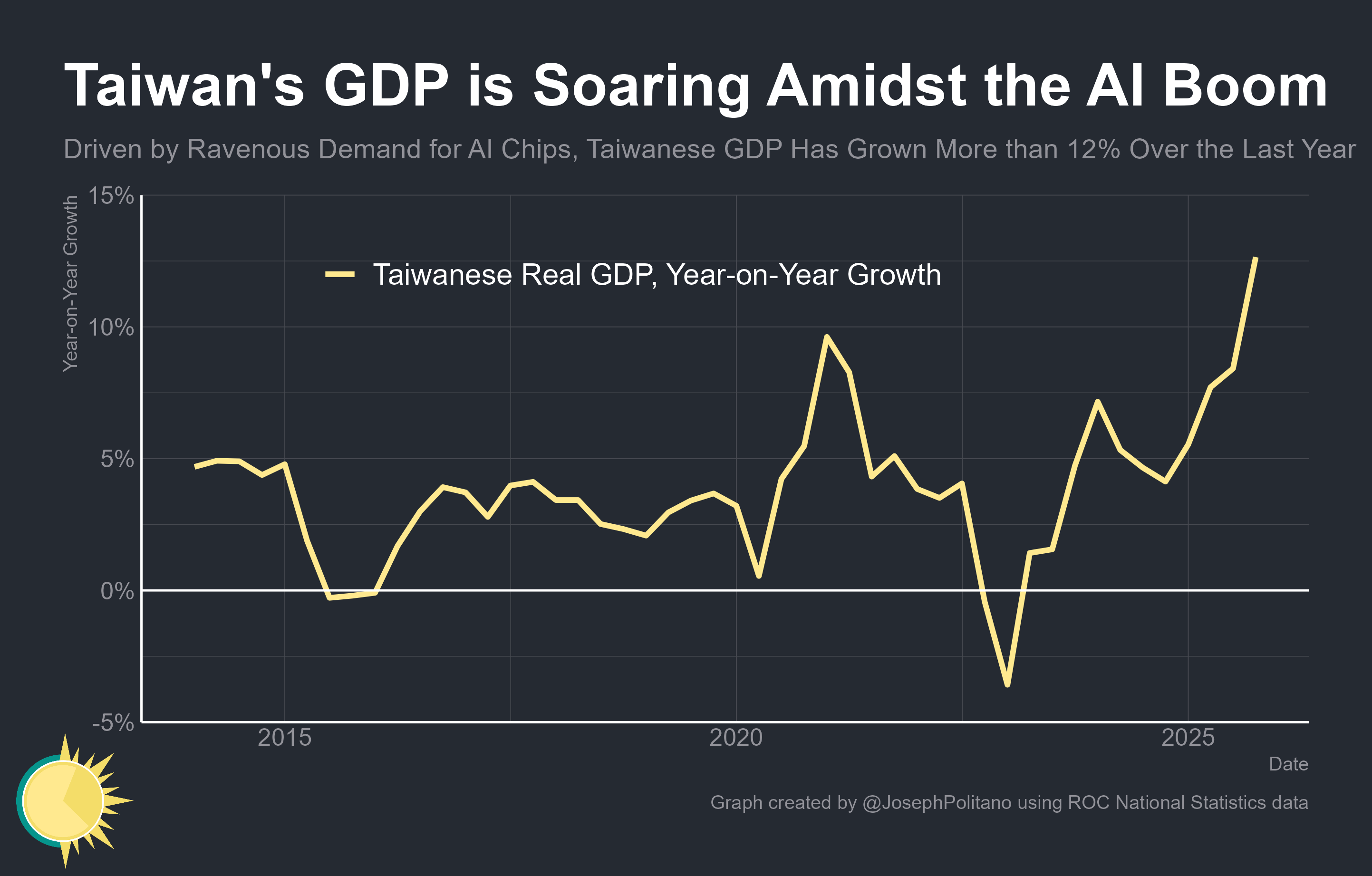
Overall, the Taiwanese economy has grown more than 12% over the last year, the fastest annual growth rate in nearly 50 years, and GDP has increased almost 23% since the launch of ChatGPT in late 2022. Industrial production and export orders have both hit record highs. Gross exports exceed $63B per month, more than double the pre-COVID average. Manufacturing now makes up nearly 40% of the nation’s economy, the highest since the late 1980s. The global rush for artificial intelligence has been a massive boon to the island nation, pushing its economy back to the growth rates that characterized its post-WWII economic miracle.
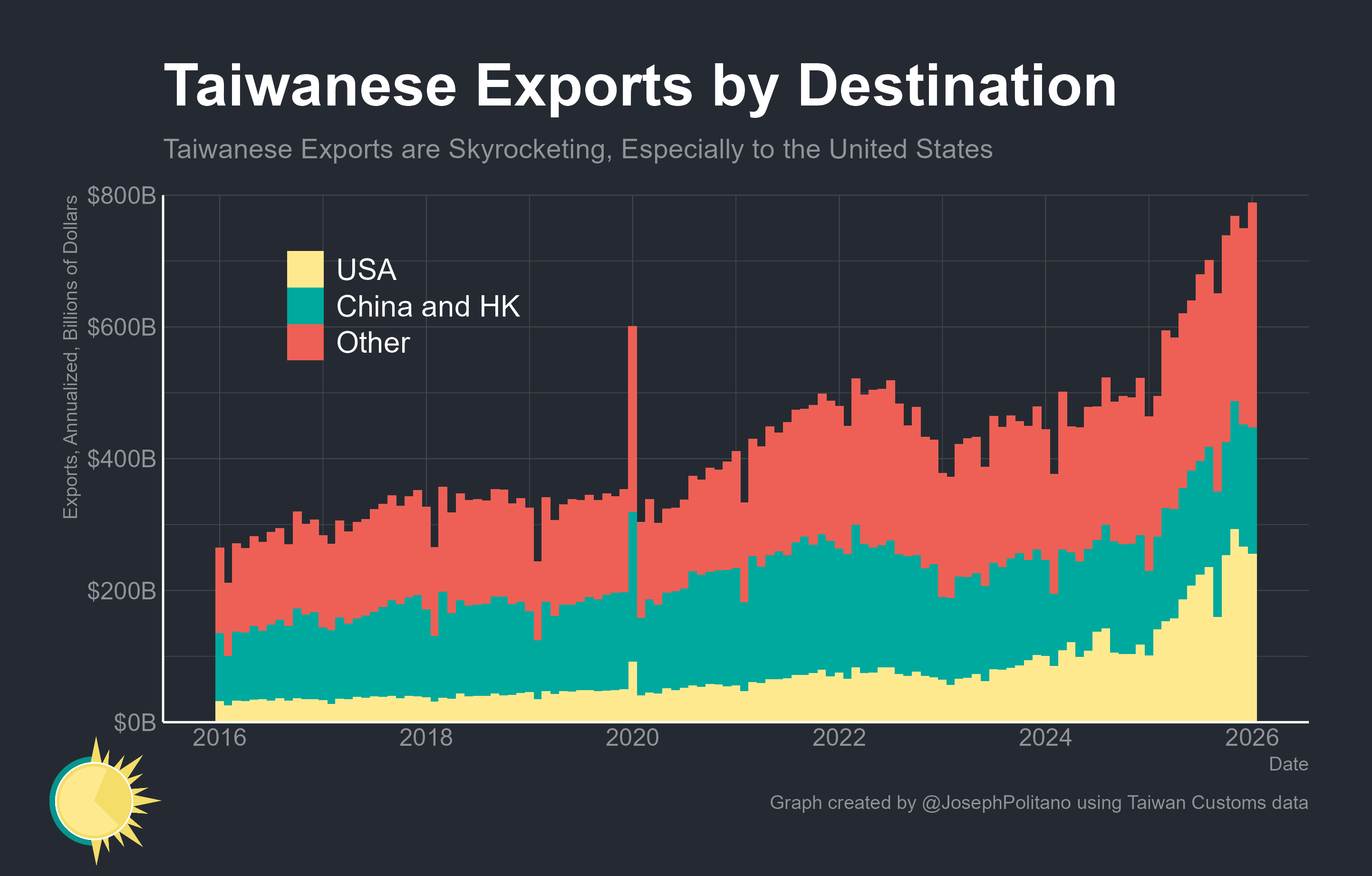
Yet Taiwan’s still caught in a difficult position as the world’s largest producer of cutting-edge chips and the primary manufacturer for AI chip designer NVIDIA. On one side of it is China, Taiwan’s chief geopolitical foe, the world’s second-largest consumer of computing power, and a country that has repeatedly shaken traditional AI behemoths with models like Qwen and Deepseek. On the other side is the United States—dependent on Taiwan for chips, desperate to contain China’s AI ambitions, and paradoxically hoping to keep China dependent on American companies’ hardware and software. Taiwan’s exports both across the strait and across the Pacific have skyrocketed over the last year, rising more than 70% as the US and China invest hundreds of billions in developing smarter AI models.
Taiwan needs to maintain this “silicon shield” of high-end chip manufacturing to counter geopolitical threats—as long as the PRC is dependent on Taiwan’s semiconductors, it is much less likely to attack the island, and as long as the US is dependent, it is much more likely to rush to Taiwan’s aid. For the same reason, both China and the US hope to pull semiconductor manufacturing away from the island to reduce their security dependence on Taiwan. China has undergone a long period of steadily indigenizing semiconductor production through national industrial policy, while the US built heavily subsidized semiconductor fabs with the 2022 CHIPS Act and is now using tariff threats to push TSMC to move more production to America.
Yet both countries also have to balance their desire to ease security dependencies with their massive current need for AI chips that only Taiwan can provide. Working to keep as many advanced chips as possible for itself and hoping to hamstring Chinese companies’ AI development, the US government has barred the export of NVIDIA’s flagship B300 chip or the slightly pared-down B30A model that the company made specifically in hopes it would be more amenable to export control officials. Instead, the US has greenlit the export of the less-powerful NVIDIA H200s to China, provided 25% of revenues are kicked back to the US government. China originally banned imports of those H200s, negotiating for better chips and hoping to push its domestic semiconductor industry, but is now rumored to have given the green light for ByteDance, Alibaba, & Tencent to import up to 400k of them to train their own AI models.
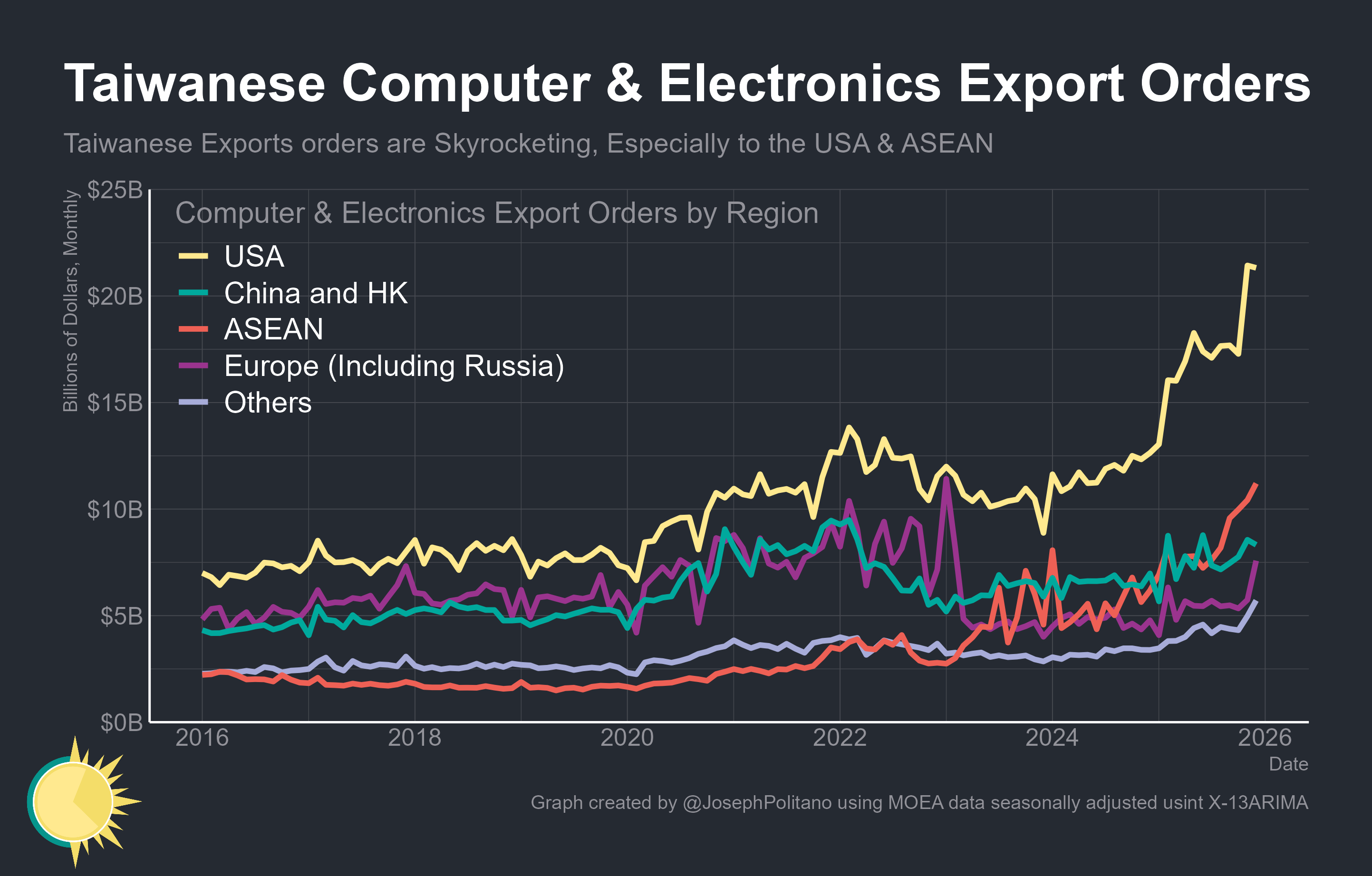
Taiwan’s economic boom is expected to continue into the near future, with the national statistics agency projecting that GDP growth will approach 8% in 2026, the third-highest growth rate this millennium. Export orders, a tight predictor for future monthly exports, hit a record high of more than $76B, up 44% over the last year. America has long been Taiwan’s top foreign customer, even surpassing China as a destination for computer parts exports in 2022, but it has rapidly expanded its lead and now dwarfs all other trading partners. Taiwanese computer and electronics export orders bound for the USA currently exceed $20B per month, more than double the next-closest major region.
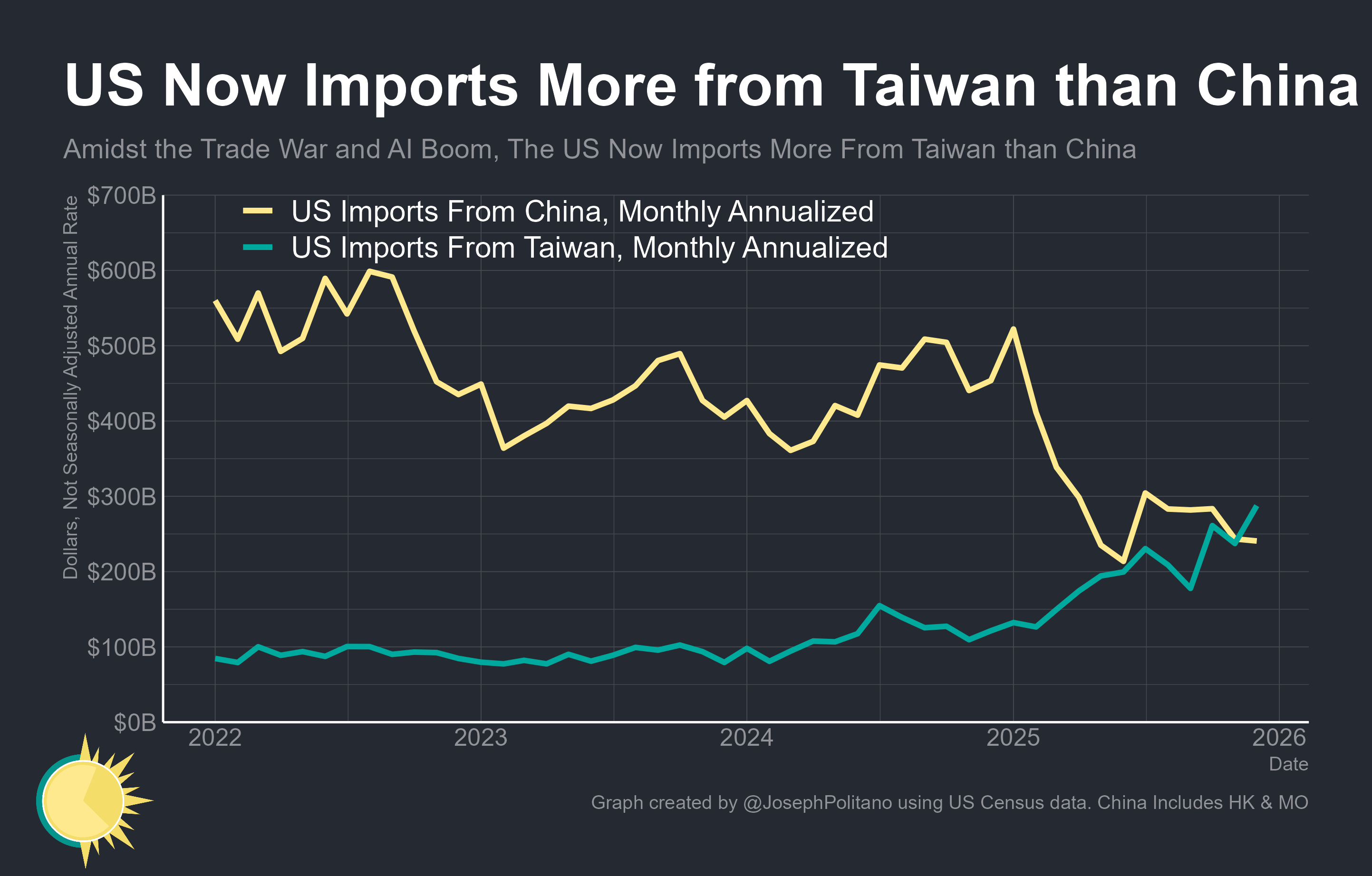
In fact, America now imports more directly from Taiwan than from China for the first time since 1992—the trade war has cut US direct trade with China, while the AI boom has caused a surge in spending on Taiwanese-made semiconductors. The US obviously imports many Chinese goods indirectly, sometimes transshipped through third countries, but much more frequently just as components of finished manufactured goods produced elsewhere. Yet the same can be said of Taiwanese chips, many of which are assembled into more complicated electronics in countries like Mexico before making their way to the US. The massive rise of Taiwanese-US trade is a genuine sea change in where America’s overseas supply-chain dependencies lie.
Yet there are still significant economic risks amidst Taiwan’s modern miracle. The massive success of TSMC reinforces the island’s two-track economy, where chipworkers prosper and the rest of the economy muddles along. The country has made major financial moves to prevent the export boom from driving currency appreciation, including deregulating many of the life insurance companies that hold foreign-currency assets. A cheap currency makes it harder for consumers to afford imports, especially food and energy, which are largely produced off the island. The country is increasingly dependent on imported LNG as it struggles to meet the power demands of semiconductor manufacturing. And of course, any reversal in the fortunes of AI companies would now hit Taiwan extra hard. The country will have to stay at the forefront of AI chip manufacturing, navigate one of the world’s tensest geopolitical rivalries, and manage a delicate macroeconomic situation to keep its economic boom going.

