

Thanks for reading! If you haven’t subscribed, please click the button below:
By subscribing, you’ll join over 75,000 people who read Apricitas!
Just one year ago, Elon Musk rushed into the White House as the head of the newly formed “Department of Government Efficiency”, or DOGE, aiming to radically shrink the federal government. Without approval from Congress, DOGE attempted to functionally dissolve the Department of Education, the Consumer Financial Protection Bureau, the United States Agency for International Development, the US Institute of Peace, and several other agencies. The civil servants in charge of the Bureau of the Fiscal Service, the Internal Revenue Service, and the Social Security Administration were all bumped aside as Elon aimed to control key spending processes in the federal government. Grants for universities, charities, businesses, and scientists were temporarily withheld or cancelled. Musk fired tens of thousands of federal employees and pushed all those remaining to take the opportunity to resign.
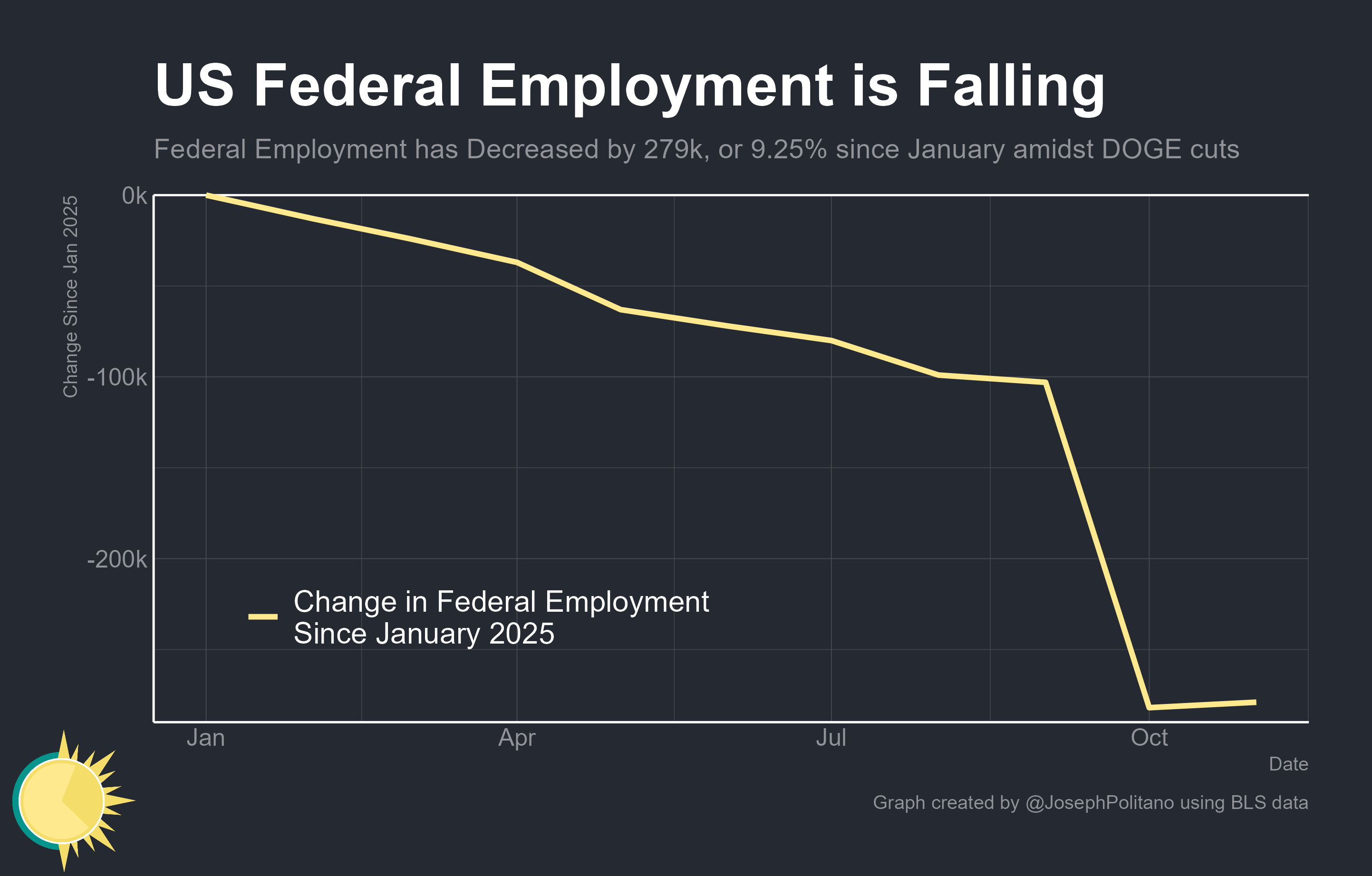
After a chaotic six months, DOGE itself was functionally shuttered, and Elon was out as part of a then-acrimonious breakup over his opposition to the increased deficit spending in the “One Big Beautiful Bill.” Yet it took until today before we could finally examine the macroeconomic impacts of DOGE, as all the federal employees on deferred resignation programs were only formally laid off near the end of 2025.
DOGE’s legacy is officially the single-largest annual decline in the federal workforce in 75 years—with total federal employment down by roughly 277k, or more than 9%, since Trump’s inauguration. That’s as large as the drop in employment seen at the end of the Korean war or during the post-Cold War “Peace Dividend,” except concentrated over a period of less than a year and focused more heavily on civilian instead of military employment. It’s also a stark contrast from Trump’s first term, which saw total federal employment rise by 70k. The share of the US workforce employed by the federal government, already hovering near historical lows before DOGE, was knocked down to the lowest level in modern history.
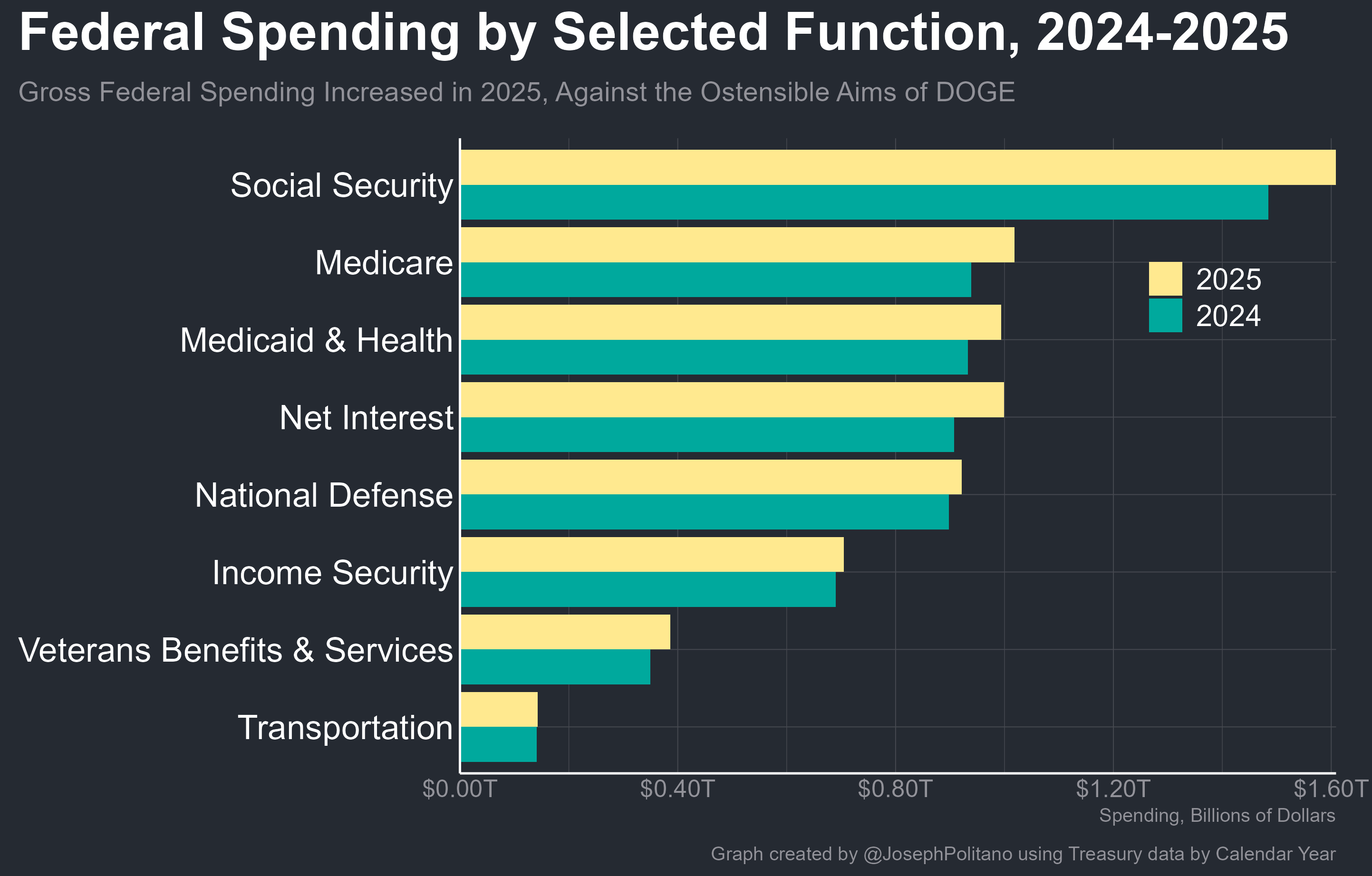
However, DOGE was not able to come close to Elon’s promised trillions in cuts to overall federal spending, which is dominated not by administrative expenses but by Social Security, public health insurance, income redistribution programs, interest, and the military. The supposed “hundreds of billions in fraud” in those major spending programs were never found because fraud is nowhere near that common, contrary to the claims that Musk continues to make. Total gross federal expenditures in 2025 were roughly $7.8T, up from $7.4T in 2024, with spending up across basically all major functions.
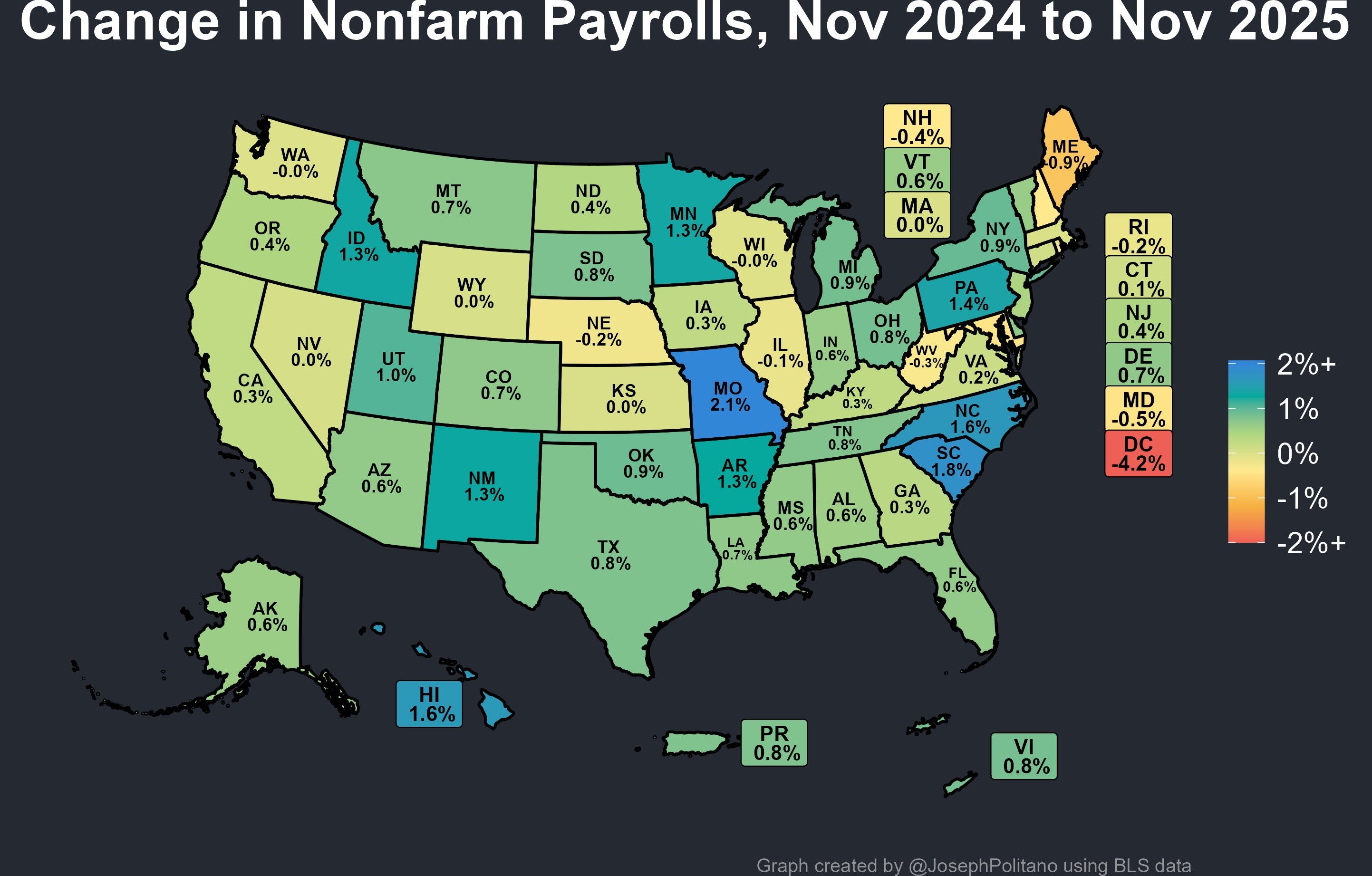
Yet even though DOGE was wholly unable to reduce the federal deficit, it still had important lasting effects throughout the economy. Washington, DC, is now in a localized recession, with the city losing 4.2% of all its jobs over the last year—the district’s fastest pace of decline in 75 years outside of the early pandemic. In nearby Maryland and Virginia, which also have significant federal presences, employment is down 0.5% and up a meagre 0.2%, respectively. Yet federal jobs were lost in every single US state and territory, with 80% of the drop in federal employment occurring outside of the broader DC area, boosting overall unemployment across the country. Many of the government’s most important science and health agencies saw severe employment losses that it will be difficult to recover from—and of course, the heavy cuts to the extremely small share of the budget spent on effective international aid programs will harm long-run global economic growth.
Who Got DOGE’d?
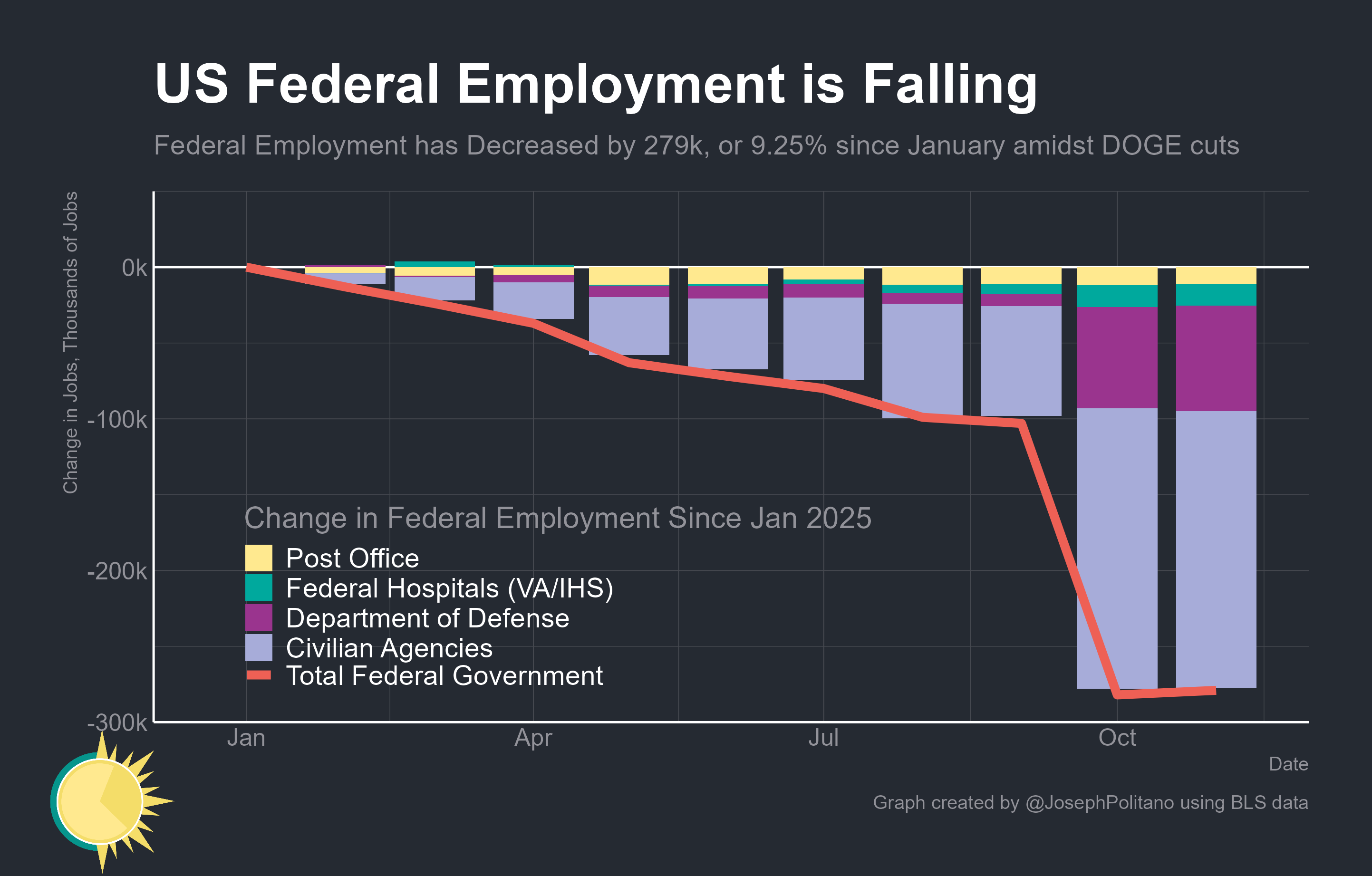
By and large, federal workers can be split into four categories. First, there are the 1.5M bureaucrats, administrators, lawyers, analysts, social workers, researchers, and support staff for civilian agencies. Second, there are the 600k delivery, sorting, and management workers of the US Postal Service, America’s largest state-owned enterprise. Third, there are the 560k defence employees at the Pentagon and other US military installations (though active-duty soldiers are not counted as employees). Finally, there are the 370k doctors and nurses at government-run hospitals for the Department of Veterans Affairs and the Indian Health Service. In the months since DOGE began its work, about 12.4% of nondefense civil servants were out of a job, an identical 12.4% of military employees, about 3.7% of federal hospital employees, and 1.8% of USPS employees. That means the majority of job losses, 182k of the 277k total, occurred at civilian bureaucratic agencies.
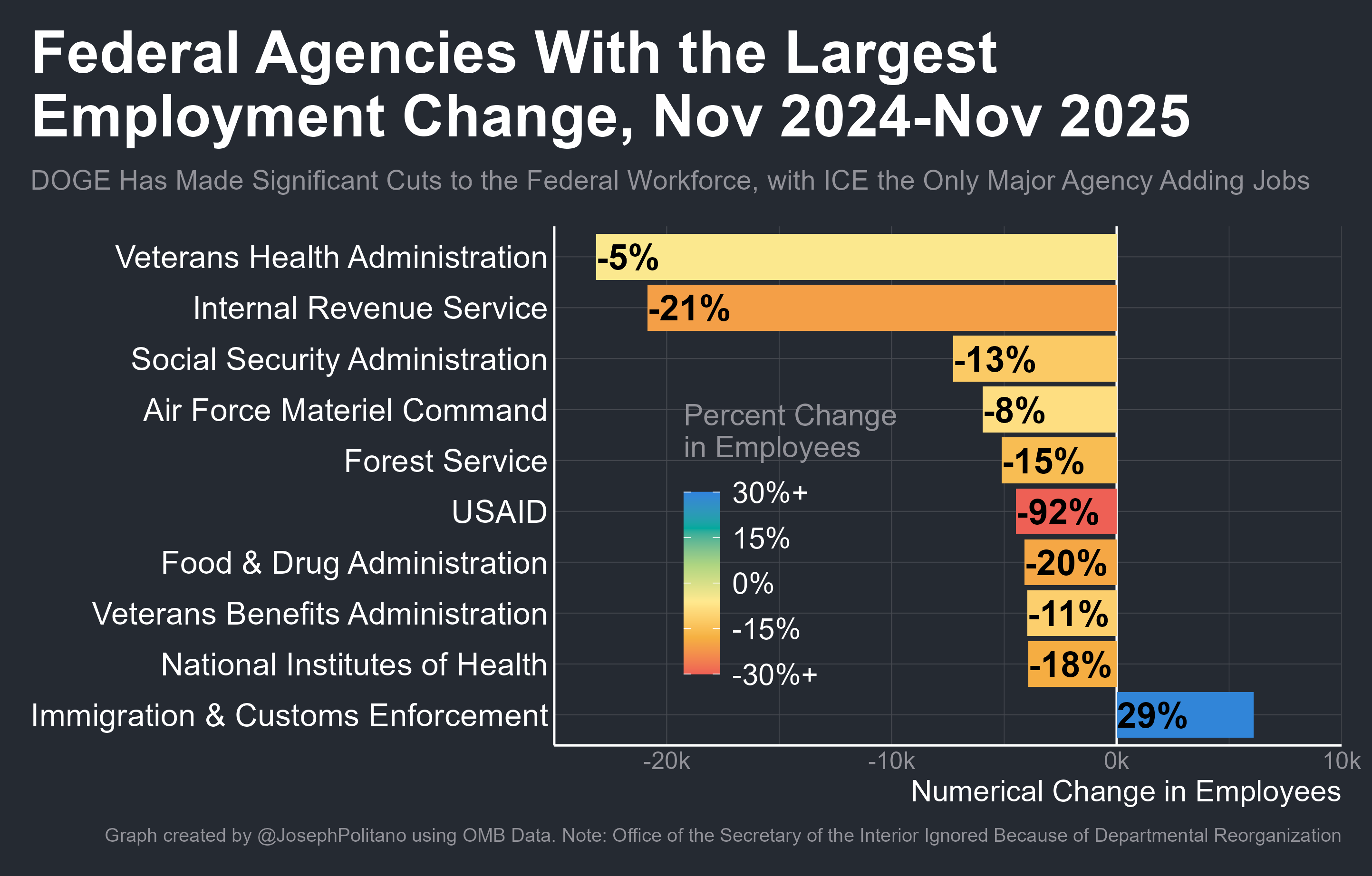
Numerically, firings at the Veterans Health Administration (VHA) were the largest source of job cuts, with the public healthcare system down more than 23k employees. Yet those job losses were only a small share of the agency’s massive 400k-strong workforce—firings at the Internal Revenue Service (IRS) were proportionately much larger, with the tax-collection agency down more than 20k of its 100k workers over the last year. IRS employment is now at the lowest level since pre-COVID, amidst ongoing administrative chaos at the agency (There have been 5 separate IRS commissioners since Trump took office, and Treasury Secretary Scott Bessent has been acting commissioner since August). From a pure fiscal deficit perspective, this is certainly the most counterproductive source of job cuts, as IRS employees raise revenue via increased enforcement by amounts that far exceed their salaries. The Food & Drug Administration, National Institutes of Health, Forest Service, and Social Security Administration are other major agencies that have seen significant employment losses.
Yet USAID was by far the single-largest reduction in percentage terms, with 92% of the agency’s nearly 5k employees fired over the last year, leaving just a skeleton crew finishing up dismantling the agency. Only tiny agencies like the Institute of Education Sciences (-87% of their 191 employees), the National Endowment for the Humanities (-73% of 216 employees), and the Agency for Healthcare Research and Quality (-64% of 297 employees) have seen firings of similar magnitudes. Even the semi-major agencies with deep cuts—like USDA Rural Development (-37%), the Bureau of the Fiscal Service (-34%), and the Small Business Administration (-31%)—don’t even come close.
The only major agency that added jobs was Immigration & Customs Enforcement (ICE), which hired roughly 6k new workers over the last year amidst Trump’s mass deportations push, while the Department of Homeland Security is the only major department that added jobs. ICE claims hiring has accelerated further in recent months and that the agency has actually added another 6k jobs since November, the last month for which official data is available. In total, this means that while DOGE did not have macroeconomically significant budget impacts, it did have important effects on the US job market.
The Labor Market Impacts of DOGE
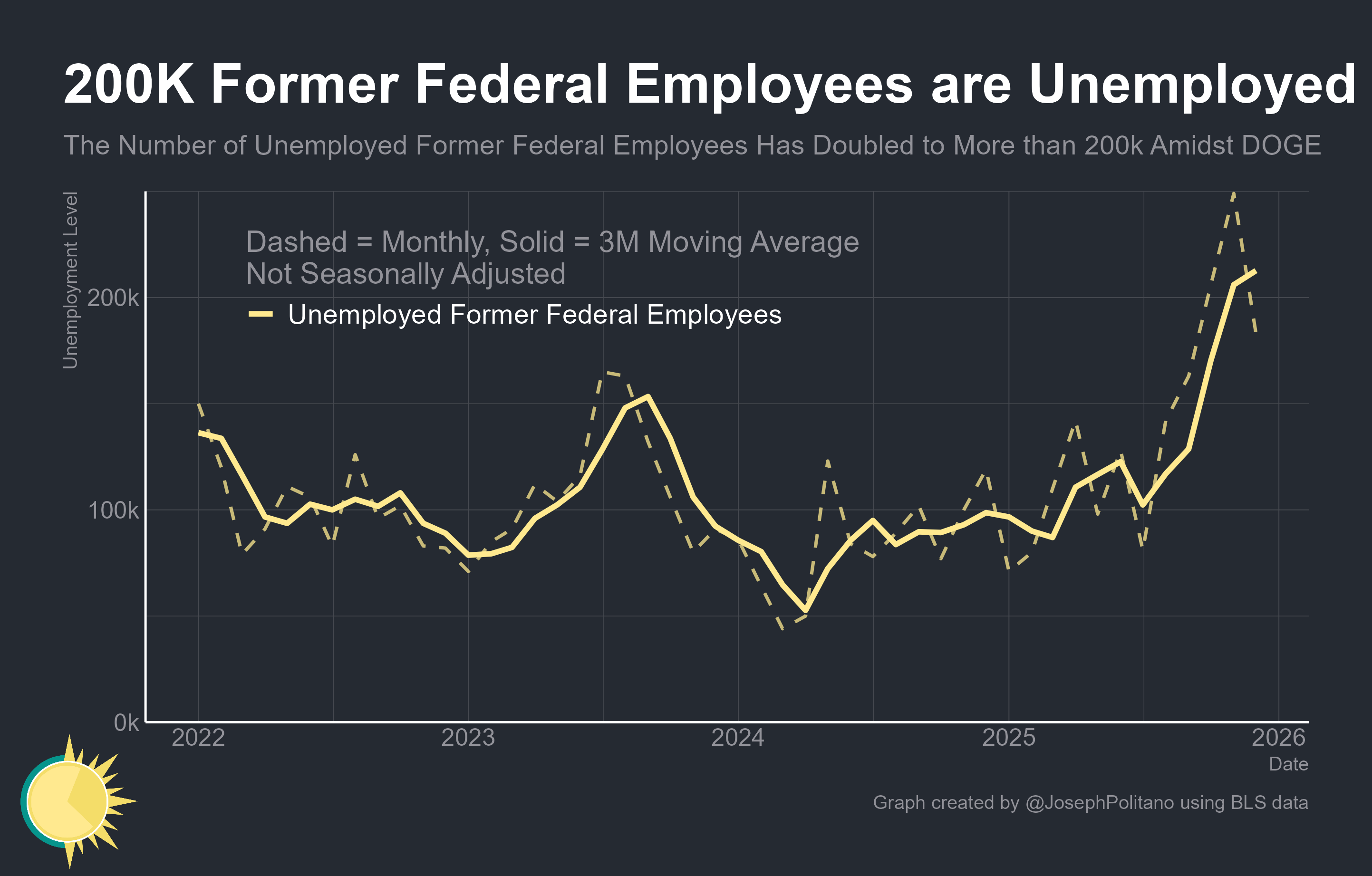
Of the net 277k federal employees who lost their jobs over the last year, roughly 40% still remain out of work amidst America’s weakening job market, pushing the unemployment rate for former feds to the highest level since early COVID. Given how many employees simply moved into retirement rather than look for other jobs, it’s plausible that an outright majority of working-age former feds are still unemployed. This is large enough to be a measurable driver of rising aggregate unemployment—total unemployment levels rose by roughly 660k over the last year, of which the rise in former federal unemployment contributed roughly 110k.